Beyond Equity & SAFEs: Introducing Options to Private Venture Markets

Venture capital execution relies heavily on two primary instruments: priced equity rounds and convertible securities (SAFEs and convertible notes). While SAFEs address early-stage valuation uncertainty, they still require immediate, full capital deployment upfront—forcing investors into an all-or-nothing check while leaving valuation adjustments for a future date. By adapting structured derivatives from public capital markets—specifically Paid Call Options and Abandonment Swaps—the venture ecosystem can establish a flexible third asset class. Instead of forcing an immediate choice between equity dilution and zero capital, option-based financing allows founders and investors to price, isolate, and trade time and capacity risk.

1. Structural Architecture of Venture Derivatives
Derivative-based startup financing formalizes future investment rights into risk-priced, legally binding instruments.
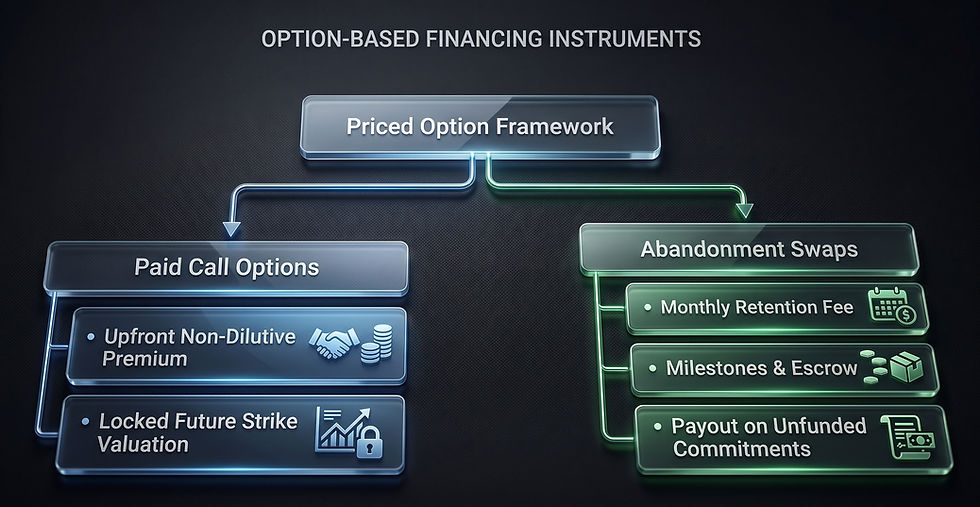
A. The Paid Private Call Option
A Paid Call Option gives an investor the right—but not the obligation—to purchase startup equity at a fixed valuation (strike price) within a defined timeframe, in exchange for an upfront, non-refundable cash premium.
Mechanics: An investor pays $50,000 upfront for the right to invest up to $500,000 at a $10 million valuation cap over the next 12 months.
Settlement Paths:
Option Exercised: The $50,000 premium converts alongside the $500,000 check into equity upon exercise.
Option Expired: The startup keeps the $50,000 as non-dilutive income, fully compensating for holding cap table availability.
B. The Abandonment Swap
Modeled on Credit Default Swaps, an Abandonment Swap transfers execution and capacity risk from the company to the capital provider.
Mechanics: An investor secures guaranteed participation in a future round by paying a recurring holding fee into escrow.
Trigger Event: If the startup hits agreed operational milestones (e.g., $500k ARR) and the investor chooses not to participate, an "Abandonment Event" triggers, automatically releasing the escrowed funds to the startup as a breakup fee.
2. Traditional vs. Derivative Financing
Dimension | Priced Equity | Convertible SAFE | Paid Call Option | Abandonment Swap |
Capital Timing | Upfront | Upfront | Two-Stage (Premium --> Principal) | Recurring Fee --> Lump Sum |
Valuation Pricing | Immediate | Capped at Next Round | Fixed Strike Valuation | Market-Based at Exercise |
Dilution Trigger | Day 1 | At Conversion | Upon Option Exercise | Upon Option Exercise |
Retention on Expiry | Equity Issued | Debt / Preferred Claim | Non-Dilutive Premium Retained | Escrowed Breakup Fee Retained |
Primary Risk Allocation | Investor Execution | Convertible Risk | Asymmetric Risk Shared | Investor Capacity Risk |
3. Key Friction Points Preventing Adoption
While mathematically optimal, deploying derivatives in early-stage venture faces structural challenges:

High Legal & Administrative Overhead: SAFEs succeeded because they eliminated negotiation costs. Drafting custom option instruments with complex milestone triggers introduces significant legal fees.
Pricing & Valuation Uncertainty: Private option pricing lacks standardized volatility inputs (σ), making it difficult to calculate fair premiums using standard Black-Scholes models.
Illiquidity & Fund Accounting: Venture funds operate under rigid LPs rules that struggle to hold or mark-to-market unexercised private derivatives.
Information Asymmetry & Misalignment: Poorly defined operational milestones create dispute risk over whether an option exercise window or breakup payout has been triggered.
4. Solutions to Overcome Market Friction
To transition option-based financing from theory to execution, the ecosystem can implement four specific structural solutions:
Solution 1: Standardized Open-Source Contracts
Just as Y Combinator standardized early-stage investing with the SAFE, an open-source framework (e.g., a Standardized Option for Financing & Equity - SOFE) would eliminate legal overhead.

Standard Terms: Standardized 10% premium rates (e.g., $50k premium per $500k option) with 6-month or 12-month fixed expiration windows.
Zero-Negotiation Execution: Pre-approved boilerplate terms allow founders and investors to sign and wire option premiums without custom legal drafting.
Solution 2: Parametric Oracle Triggers for Abandonment Swaps
To remove dispute risk around milestones, Abandonment Swaps can rely on parametric, data-driven triggers verified by third-party platforms (e.g., Stripe, QuickBooks, Carta).
Automated Verification: Revenue, active user metrics, or audit reports stream directly into an escrow protocol.
Immediate Settlement: When verified API data confirms a milestone, the investor must either deploy the capital check within 14 days or forfeit the escrowed breakup payout automatically—eliminating subjective negotiations.
Solution 3: Special Purpose Vehicle (SPV) Syndication & Secondary Trading
To solve illiquidity and fund accounting issues for institutional VCs, options can be issued directly into standardized SPVs or secondary platforms.

Transferable Option Rights: If an initial investor chooses not to exercise their call option, they can sell or transfer the option on a private secondary platform to another accredited investor before expiration.
LP Accounting Compatibility: Fund managers hold SPV shares that track clear book values, fitting standard institutional reporting standards.
Solution 4: Option Premium Credit Adjustments (The Two-Tier SAFE)
To ease adoption for traditional venture funds, option mechanics can be integrated directly into standard SAFEs as an Option-Credited SAFE:
Structure: The investor wires $50,000 today as an Option Premium SAFE.
Conversion Benefit: If the investor exercises the full round within 9 months, the $50,000 premium grants them a 5% to 10% valuation discount bonus on the main investment check.
Protection Benefit: If the investor walks away, the $50,000 converts into a simple non-voting, non-dilutive grant, providing the startup with runway without clogging the cap table.
The Path to Market Integration
Option-driven financing provides a framework for pricing time and uncertainty in venture building. As private markets mature and structured venture credit expands, secondary platforms and standardized term sheets could enable derivative instruments to sit alongside equity and debt in modern corporate capital stacks. By addressing legal friction through standardized contracts, automating execution via parametric data, and enabling secondary liquidity, derivative-based venture instruments can transition from novel financial concepts into a practical tool for modern startup capitalization.
Get Started with the SOFE Framework
To help founders and investors move from theory to execution, we have published an open-source, standardized SOFE (Standardized Option for Financing & Equity) agreement. You can inspect the complete template to customize it for your next fundraise or investment round:
Collaborate & Build with Us
We are refining derivative-based financing instruments and testing them on real-world projects, including our company Domesly.com.
Whether you are an angel investor, venture fund manager, or founder:
Interested in testing option-based rounds? Let's discuss how to structure a SOFE pilot for your investment strategy or upcoming raise.
Want to improve the framework? Help us refine the legal terms, parametric data triggers, or secondary trading mechanics.
Join our upcoming Startup-Options.com marketplace!
Get in touch directly at info@alphanome.ai


Comments