Algorithmic Calibration of Stimulus Efficiency in Endurance Systems

In our previous analysis, The Polarisation Paradox: Algorithmic Safeguards Against Mid-Zone Drift in Endurance Training, we identified how unmanaged "Grey Zone" drift destroys execution fidelity, degrading high-intensity capacity and compromising autonomic recovery. Yet, even when an athlete achieves a high Polarisation Compliance Index (PCI) by strictly segregating Zone 1/2 from high-intensity intervals, a deeper structural liability remains in classical endurance programming: the assumption that total training volume is the primary metric of progression. When training models treat volume as a proxy for adaptation, athletes face diminishing physiological returns alongside accelerating autonomic and structural risk. The solution requires moving past maximum tolerable volume to mathematically define and algorithmically enforce the Minimum Effective Stimulus (MES) required for continuous adaptation.
1. The Volume Curve: Physiological Asymmetry and Diminishing Returns
Traditional endurance paradigms scale volume linearly under the assumption that more time-in-zone yields proportional cardiovascular and metabolic gains. However, biological adaptation follows a logarithmic curve characterized by rapid marginal decay and asymmetric stress profiles.

Metabolic vs. Structural Adaptation Asymmetry
The fundamental flaw of linear volume scaling lies in the divergent adaptation timelines of different physiological systems:
Adaptation RateMetabolic >> Adaptation RateStructural
Metabolic & Vascular Systems: Capillary density, mitochondrial biogenesis (PGC-1α transcription), and stroke volume adapt rapidly under targeted stimulus.
Structural & Connective Tissues: Tendons, ligaments, bone mineral density, and extracellular matrix remodeling adapt on extended time horizons due to lower vascularization.
When total weekly volume is used to drive metabolic gains, the load required to yield incremental cardiovascular changes frequently exceeds the structural tolerance threshold, leading to overuse pathologies and collagen degradation.
Autonomic Saturation and Parasympathetic Suppression
Extended volume accrual increases total internal load (Trimp) non-linearly. Beyond a critical duration threshold, prolonged activation of the sympathetic nervous system leads to sustained catecholamine exposure, glycogen depletion, and elevated basal cortisol. The result is non-functional overreaching (NFO), where added volume actively suppresses the parasympathetic state necessary to assimilate training stress.
2. Defining the Minimum Effective Stimulus (MES) Engine
The Minimum Effective Stimulus (MES) is the minimum input required to trigger a targeted biological adaptation without incurring excess autonomic fatigue or structural debt. Instead of prescribing arbitrary duration targets, an MES-driven system models workouts as precise adaptation-to-fatigue ratios:
By isolating the physiological signaling pathways responsible for specific endurance markers, we can restructure workout profiles to optimize the SEI across key performance limiters:
Physiological Target | Underlying Mechanism | Traditional Prescriptive Method | Minimum Effective Stimulus (MES) Protocol |
Mitochondrial Density | Up-regulation of PGC-1α transcription | 3–5 hour Long Slow Distance (LSD) | 45–75 min steady at LT₁ (Zone 2) with locked Cadence Dynamics |
VO₂max & Stroke Volume | End-diastolic stretching & myocardial load | High weekly baseline volume + broad intervals | 4 times 4 min @ 90–95% HRmax (High-Density Intermittent Load) |
Lactate Clearance Threshold (LT₂) | MCT1 / MCT4 transporter expression | 45–60 min steady state tempo | 3 times 10 min Over/Under Threshold (105% / 90% LT₂) |
Tendon Stiffness & Economy | Force-length vector adaptation | High weekly mileage accrual | Heavy resistance (2 times/week) + high-load isometric/plyometric work |
3. Algorithmic Control: Continuous Progression Without Volume Expansion
In an open-loop training environment, progressive overload is achieved by increasing session duration or weekly mileage. In a closed-loop MES engine, volume remains bounded while progression is unlocked through Density, Precision, and Dynamic Resistance Adjustment.
Step 1: Real-Time Efficiency Factor (EF) Tracking
Progressive adaptation is validated by tracking the relationship between external output (Watts or Pace) and internal cost (Heart Rate) within the targeted metabolic domain:
If an athlete's EF during a standardized Zone 2 block rises over successive micro-cycles while HRV stability remains high, the current stimulus remains effective. Volume expansion is blocked.
Step 2: Density Modulation Over Duration Expansion
Rather than extending a 60-minute Zone 2 ride to 90 minutes when adaptation occurs, the system compresses the stimulus window or increases the micro-density:
Rest Compression: Decreasing inter-interval recovery periods while maintaining target power thresholds.
Target Narrowing: Tightening power bands around LT₁ or LT₂ to eliminate intra-session power drop-offs without extending total duration.
Step 3: Closed-Loop Volume Gating
Volume expansion is governed strictly as an exception handling protocol. An algorithmic increase in training duration is authorized only when all three conditions are satisfied:
EF Plateau: The Efficiency Factor exhibits zero statistically significant variance (p < 0.05) across 14 consecutive days.
Autonomic Reserve: Parasympathetic markers (7-day rolling RMSSD) are equal to or above historical baselines.
High PCI Score: The athlete maintains a Polarisation Compliance Index > 0.90, verifying that existing stress is not being corrupted by mid-zone drift.
4. Architectural Implementation in Closed-Loop Training Systems
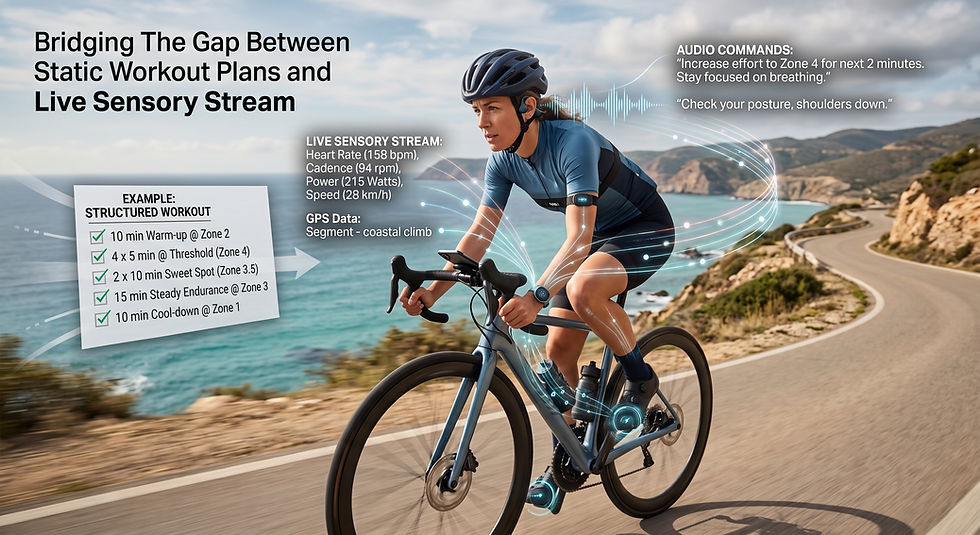
Integrating Minimum Effective Stimulus logic into adaptive training systems transforms the platform from a passive scheduler into an active controller. By combining real-time biofeedback loops with algorithmic safeguards against both Mid-Zone Drift (via high PCI) and Volume Drift (via capped MES Prescriptions), closed-loop training engines can drive continuous performance gains while minimizing structural fatigue, chronic sympathetic load, and injury risk.
Core Closed-Loop System Design
The Paradigm Shift
Continuous progression in endurance training does not require continuous volume expansion.
By mathematically decoupling adaptation from duration, training platforms can deliver maximum performance output at the absolute lowest biological cost—shifting the goal from how much load an athlete can handle to how efficiently a target adaptation can be triggered.




Comments