Beyond Passive Numbers: Why the Future of Running Power Is Active, Real-Time Coaching

For the past decade, running power has lived in a paradox. Sensors like Stryd, Garmin, and Coros unlocked a metric that promised to do for runners what strain gauges did for cyclists: measure true mechanical effort regardless of hills, wind, or cardiac drift. Yet for most athletes, running power has remained a passive experience—a three-digit number flashing on a wrist screen mid-stride, followed by a post-run post-mortem on Strava or TrainingPeaks. At Domesly, we believe that looking down at a watch to interpret raw wattage is already becoming obsolete. Having pioneered real-time, active voice coaching and sub-150ms biometric edge computing for high-performance cyclists—acting as a digital Directeur Sportif in the athlete's ear—we see the exact same inflection point arriving for running. The future of running power isn't just about building a slightly more accurate footpod; it is about closing the gap between raw sensor telemetry and instantaneous, eyes-up execution.
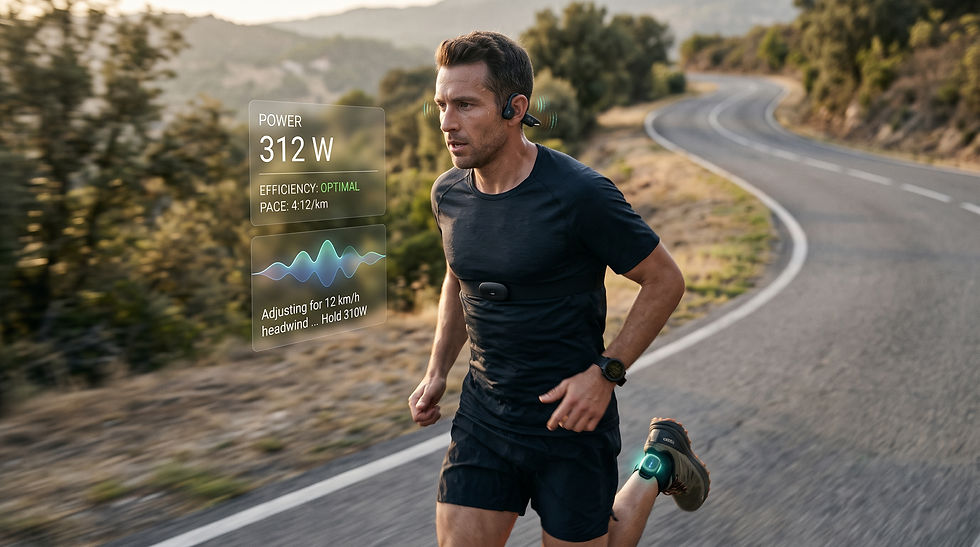
From Post-Run Analytics to In-Stride Edge Intelligence
Legacy training platforms excel at pre-workout planning and post-workout analysis, telling you after a marathon that you burned too many matches on the climbs at mile eight. Even live watch alerts rely on rigid, static thresholds—beeping endlessly when your power drifts five watts above target on a gusty straightaway. The next generation of running power moves the brain to the edge. By fusing live Bluetooth Low Energy (BLE) power streams with heart rate, cadence, and environmental context directly on-device, edge AI models can track dynamic physiological states—such as real-time anaerobic work capacity (W' balance) and fatigue curves—while you are still moving. Instead of forcing a runner to do mental math at threshold pace, active systems translate those numbers into concise, context-aware voice directives delivered via open-ear bone-conduction audio:
"Headwind picking up—hold 285 watts, let your pace settle by six seconds."
"You're dipping into anaerobic reserve too early on this climb. Ease back ten watts to protect your final 5K."
When feedback arrives in your ear within milliseconds of a terrain or wind shift, you never break form, never glance at your wrist, and never waste cognitive energy decoding data screens.
Multi-Sensor Fusion Over Single-Metric Dogma
One of running power's biggest historical limitations is that mechanical output alone does not capture internal metabolic cost or late-race biomechanical breakdown. Holding 300 watts in kilometer one feels vastly different from holding 300 watts in kilometer thirty-five when muscle fibers fatigue and ground contact time lengthens. The future belongs to sensor-agnostic fusion rather than isolated wattage silos. As standardized wireless protocols allow simultaneous streaming across footpods, optical wearables, and chest straps, intelligent coaching engines can cross-reference mechanical power against cardiovascular drift and stride mechanics in real time. When your mechanical power stays flat but your heart rate decouples and leg spring stiffness drops, an active coaching layer recognizes true fatigue—and adjusts your pacing cues before you hit the wall.
Eliminating the "Learning Curve" Barrier
Until now, training with power required a steep learning curve: running critical power tests, memorizing zone tables, and navigating incompatible wattage scales across brands. That friction kept power confined mostly to data-obsessed runners and triathletes. Active audio coaching removes that barrier entirely. A runner does not need to know whether their Stryd pod reads 20 watts higher than a Garmin watch if an adaptive voice coach calibrates to their personal baseline and tells them—in plain, human language—when to push, when to hold, and when to recover.
The Road Ahead
Cycling proved that power meters transform endurance performance once athletes know how to act on the data. For runners, the hardware foundation is already here. What comes next is turning silent numbers into an active partner—one that watches your telemetry every millisecond so you can keep your eyes on the road ahead. To see how this real-time audio coaching model works in practice on the road, watch the Domesly Active Coaching Demo, which showcases how live sensor telemetry and bone-conduction voice cues guide athletes mid-effort.


Comments