Bridging The Gap Between Static Workout Plans and Live Sensory Stream

In our previous explorations of endurance performance, we examined two systemic breakdowns in training execution:
The Polarisation Paradox, which exposed how athletes unintentionally drift into the non-adaptive "Grey Zone" (between the first and second ventilatory thresholds, VT₁ and VT₂, diluting high-intensity capacity and accumulating unearned autonomic fatigue.
The Psychology of the Soft Pedal, which unpacked the cognitive friction, hesitation, and interoceptive miscalibration that prevent athletes from easing off or making clean, sharp interval transitions during live efforts.
Together, these concepts reveal a fundamental flaw in modern endurance training: the open-loop gap. Athletes import structured workouts from platforms like TrainingPeaks or Intervals.icu onto head units, but execution is left to human self-regulation under dynamic real-world conditions. To solve this, we must transition from passive visual feedback to a closed-loop telemetry engine. By transforming planned workout structures into a continuous target vector and comparing it against incoming sensory data (Power, Heart Rate, and Cadence etc.), we can algorithmically enforce correct training execution in real time.
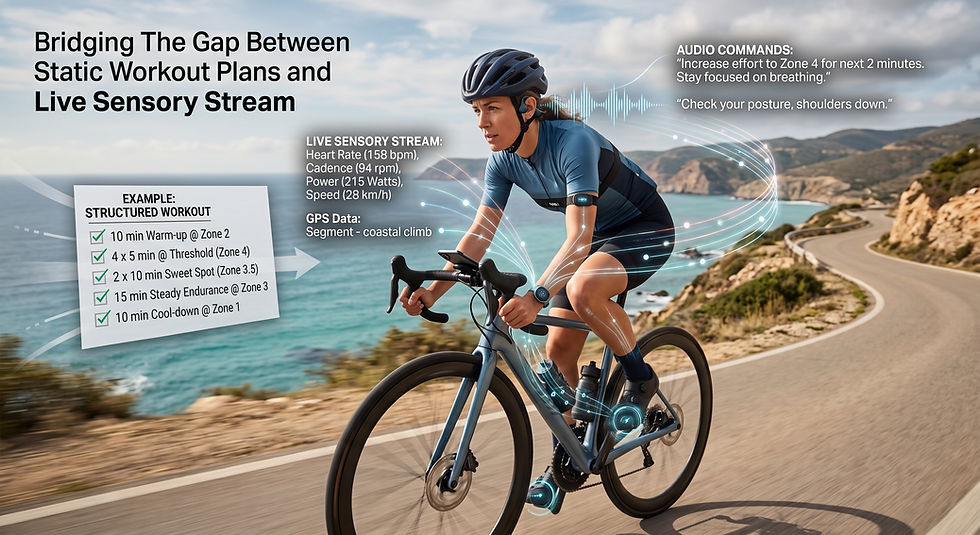
1. The Real-Time Comparison Framework
Evaluating compliance is not as simple as checking if At = Pt. Raw biological and mechanical data stream with noise, delays, and environmental interruptions. A deterministic engine must account for three core physiological and telemetry realities:
Signal Noise vs. Real Effort: Instantaneous pedal stroke spikes or terrain changes create single-second power surges that do not represent intentional intensity changes.
Autonomic Latency (HR Lag): Heart rate response lags behind mechanical power output by 30 to 60 seconds at the start of an interval step.
Environmental Disruption: Traffic stops, descent coasting, and urban obstacles temporarily force zero-power or zero-cadence states.
2. Rule Architecture for Real-Time Stream Comparison
To resolve these challenges, the rules engine operates on smoothed rolling evaluation windows, dynamic grace periods, and prioritized decision logic.
Rule 1: Signal Noise Smoothing (3-Second Power Window)
To prevent constant false alarms from brief torque surges, instantaneous power is smoothed using a 3-second rolling average.
Compliance Zone: The 3-second average power remains within target power boundaries.
Breach Threshold: Power exceeds the upper ceiling by > 5% or drops below the lower floor by > 5% for more than 5 consecutive seconds.
Action: Trigger a directional intensity prompt ("Ease Off" or "Increase Torque").
Rule 2: The Soft-Pedal Enforcement (Grey Zone Safeguard)
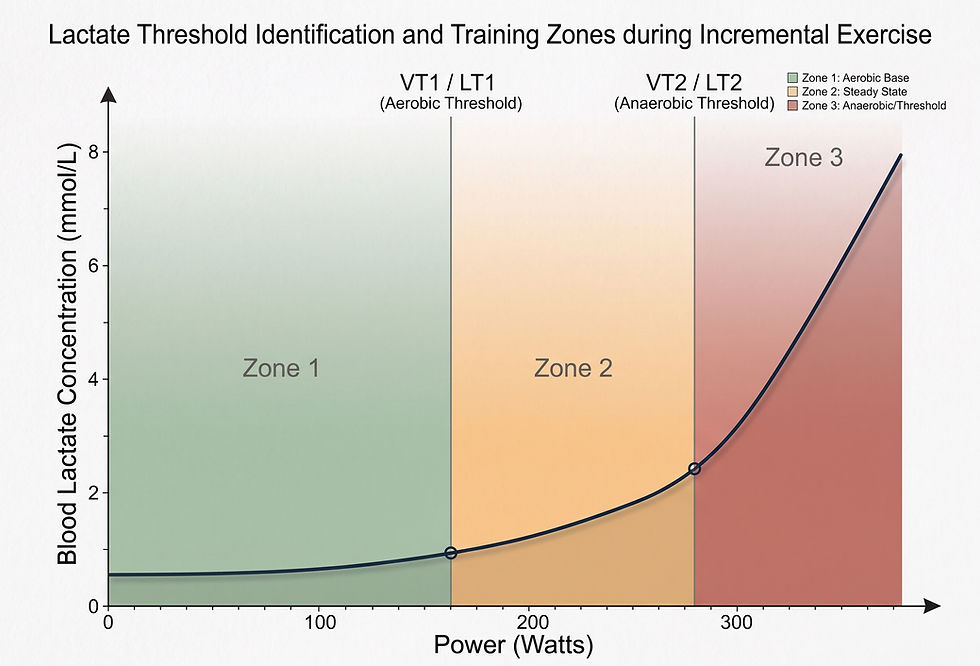
During designated Zone 1 active recovery or low-intensity aerobic endurance blocks, any drift past the VT₁ aerobic threshold invalidates the session's biological objective.
Trigger Condition: Target step is Zone 1, but 3-second power exceeds VT₁ ceiling for > 5 seconds.
Action: Immediate visual/audio warning enforcing the cognitive "soft pedal"—instructing the rider to back off before sympathetic nervous system activation elevates lactate accumulation.
Rule 3: Autonomic Grace Windows & Cardiac Drift
Because heart rate takes time to catch up to power increases, applying strict HR boundaries immediately during a hard interval creates false compliance failures.
Grace Window: Freeze heart rate ceiling validation during the first 30 seconds of any new interval step.
Cardiac Drift Tracking: After the 30-second window, if power output is stable within target bounds but rolling 10-second heart rate exceeds maximum target thresholds for > 20 seconds, classify the event as Cardiac Drift.
Action: Flag autonomic fatigue or overheating without forcing an immediate decrease in power if target effort is still being maintained.
Rule 4: Drivetrain Efficiency & Cadence Anchoring
Cadence checks ensure the rider maintains mechanical efficiency without grinding or spinning out.
Filter: Ignore cadence compliance if live power is below 20W (coasting).
Trigger Condition: Live power is ≥ 20W and cadence falls below minimum step target by > 10 RPM for > 8 seconds.
Action: Shift advisory prompt ("Shift Down / Increase Cadence").
Rule 5: Auto-Pause and Telemetry Fault Handling
To prevent stopped time from corrupting interval timers or target duration analytics:
Traffic Stop: Cadence reads 0 RPM, power reads 0 W, and speed drops below 2 km/h for > 3 seconds. The engine freezes interval progression.
Sensor Dropout: If any telemetry metric returns null or dead-level readings for > 5 seconds, the system triggers a sensor battery/connection alert and falls back to secondary streams (e.g., HR-based monitoring if power drops out).
3. Real-Time Telemetry Priority Matrix
When multiple conditions occur simultaneously, the engine processes inputs through a strict hierarchy to ensure safety and system integrity take precedence over performance prompts:
Priority Class | Rule Name | Trigger Condition | Engine Action |
P0 (Critical) | Hardware Fault | Power or Cadence signal lost (> 5s) | Issue sensor reconnection prompt |
P1 (Execution) | Auto-Pause | Cadence = 0, Speed < 2 km/h (> 3s) | Freeze workout execution timer |
P2 (Safeguard) | Grey Zone Drift | Zone 1 step, Power > VT₁ (> 5s) | Soft-Pedal Enforcement Alert |
P3 (Target) | Intensity Deviation | Power outside ± 5% target range (> 5s) | Directional adjustment feedback |
P4 (Efficiency) | Cadence Low | Cadence < Targetmin at Power > 20W (> 8s) | Gear change advisory |
P5 (Diagnostic) | Cardiac Drift | HR > Targetmax post-30s grace window (> 20s) | Flag autonomic strain state |
By shifting from passive visual display monitoring to an automated rule engine, we remove the cognitive burden of decision-making from the athlete mid-ride. When easy sessions are deterministically constrained below VT₁ and high-intensity efforts are structured with exact signal-cleansing parameters, training polarization ceases to be an abstract coaching ideal—it becomes an unavoidable consequence of closed-loop execution.
4. Translating Telemetry Deviations into Minimalist, Direct Cognitive Audio Cues
In high-intensity efforts or dynamic road environments, expecting an athlete to continuously look at a visual display introduces visual task-switching latency, safety risks, and cognitive overhead. Visual dashboards are passive; they show data, but they do not enforce decisions. To bridge the final gap between closed-loop telemetry and human execution, we must design an Audio Cue Feedback Architecture. This system translates rule triggers into ultra-concise, non-fatiguing audio prompts delivered via bone-conduction headsets or smart helmets.
5. Neuro-Acoustic Design Principles for In-Ride Cues
A real-time audio coaching engine must operate under strict psychoacoustic constraints. Continuous talking or long sentences increase cognitive load, leading to "alert fatigue" where the rider begins tuning out notifications. To optimize compliance without cognitive burnout, audio instructions follow four acoustic guidelines:
Imperative Verb First: Lead with the required action, not the metric or problem (e.g., "Soft pedal" rather than "Your power is currently 30 Watts over your Zone 1 aerobic threshold ceiling").
Numeric Delta over Absolute Value: State the exact required shift rather than the absolute target (e.g., "-20 Watts" is processed faster mid-effort than listening to "Target is 180, you are at 200").
Earcon Tonal Anchors: Precede critical priority breaches with distinct sub-second auditory chimes (earcons) so the brain categorizes priority tier before speech processing begins.
Adaptive Cadence Speech: Synthesize text-to-speech engine delivery speed based on heart rate zone—faster, terse prompts during Zone 3/VO₂ Max efforts; calm, measured tones during Zone 1 active recovery.
6. Telemetry Trigger to Audio Instruction Mapping
The table below details how rule breaches within the telemetry comparison loop translate directly into real-time audio prompts, sound cues, and pacing structures.
Priority Class | Telemetry Trigger State | Earcon Sound Cue | Synthetic Audio Voice Output | Execution Objective |
P0 (Critical) | Sensor Dropout: Power or Cadence NULL (> 5s) | Low Double Beep (440Hz) | "Check power meter connection." | Diagnostic warning |
P1 (Execution) | Traffic Stop / Auto-Pause: Cadence = 0, Speed < 2 km/h (> 3s) | Single Soft Chime (587Hz) | "Workout paused." | Freeze interval timer |
P2 (Safeguard) | Grey Zone Drift: Recovery Step, Power > VT₁ (> 5s) | Warning Dual-Tone (300Hz-200Hz) | "Soft pedal. Drop 25 Watts." | Soft-Pedal Enforcement |
P3 (Target High) | Over-Power Interval: Power > Targetmax X 1.05 (> 5s) | Descending Chime (880Hz-660Hz) | "Ease off. Ease off. -15 Watts." | Prevent early interval blowout |
P3 (Target Low) | Under-Power Interval: Power < Targetmin X 0.95 (> 5s) | Ascending Chime (660Hz-880Hz) | "Push hard. +20 Watts." | Overcome cognitive pause |
P4 (Efficiency) | Cadence Low: Cadence < Targetmin at Power > 20W (> 8s) | Click Tone (1000Hz) | "Shift down. Increase cadence." | Mechanical torque efficiency |
P5 (Diagnostic) | Cardiac Drift: HR > Targetmax post-30s grace window (> 20s) | Neutral Bell (523Hz) | "High cardiac strain. Power on target." | Informational awareness |
7. Audio Encodings Across Specific Scenario States
Scenario A: Enforcing the "Soft Pedal" during Zone 1 Recovery
The athlete finishes a 4-minute Zone 3 VO₂ max interval and transitions into a 3-minute Zone 1 active recovery block. Fresh off the interval, catecholamines are surging, and the athlete continues pushing 230W into a slight uphill grade, completely missing the recovery intention.
Second 0: Interval step changes to Zone 1 (Target: 120W - 150W, VT₁ ceiling: 160W).
Second 1–30 (Grace Window): Power is dropping slowly (230W → 190W).
Second 35 (Trigger Breach): 3-second power averages 185W (> VT₁ ceiling) for > 5 consecutive seconds.
Audio Engine Output:
[Earcon: Low Warning Dual-Tone]
Voice Prompt: "Soft pedal. Drop 30 Watts. Protect your next interval."
Second 45 (Follow-up Check): If power remains above 160W:
Voice Prompt: "Back off."
Scenario B: Overcoming the "Cognitive Pause" at Interval Onset
The workout dictates a sudden step increase from 150W recovery to a 400W Anaerobic Capacity (W') effort. The athlete hesitates at the transition, slowly ramping up over 10 seconds rather than hitting the target immediately.
Second -5 (Pre-Cue): Engine prepares the athlete for the upcoming step transition.
Voice Prompt: "Interval in 5... 4... 3... 2... 1... Stand and drive!"
Second 5 (Post-Step Evaluation): 3-second power is only sitting at 320W (target: 400W).
Audio Engine Output:
[Earcon: Ascending Dual-Tone]
Voice Prompt: "Surge now. +80 Watts. Drive the pedals."
Second 15 (Target Achieved): Power reaches 405W.
Voice Prompt: "Locked in. Hold 400."
Scenario C: Managing Cardiac Drift and Heat Stress
During a 20-minute threshold effort (280W target), the athlete is maintaining 282W accurately. However, ambient heat causes progressive cardiovascular drift—heart rate climbs past the target 165 BPM ceiling to 178 BPM while power stays flat.
First 30 Seconds: HR grace window active—no alerts triggered.
Minute 12: 10-second average heart rate reaches 176 BPM for > 20 consecutive seconds while 3-second power is perfectly compliant at 281W.
Audio Engine Output:
[Earcon: Single Neutral Bell]
Voice Prompt: "Power on target. Heart rate drifting high (+10 BPM). Focus on deep breathing and cooling."
8. Audio Feedback State Flow
The deterministic engine processes inputs and dispatches audio events through a clear lifecycle loop:
By elevating the real-time rule engine with a dedicated Audio Cue Architecture, closed-loop training execution reaches its full potential. The athlete no longer scans screens or calculates rolling averages in their head. The deterministic engine continuously listens to the sensory stream, filters out signal noise and physiological lag, and delivers clear audio instructions right when action is required. Easy rides stay strictly below VT₁, hard intervals are hit with precision, and cognitive hesitation is eliminated.



Comments