Closed-Loop Cybernetic Intelligence in Cycling: Real-Time Active Coaching via Multi-Sensor Fusion and Edge-AI Intervention Architecture

The Shift from Telemetry Display to Cybernetic Control
Our previous analyses established the foundational pillars of AI-augmented endurance sports technology. In Part I, we demonstrated how shifting metric presentation from visual head units to directional auditory channels optimizes cognitive ergonomics, preserving visual-spatial working memory and mitigating sensorimotor conflict during high-speed, dynamic riding. In Part II, we resolved the temporal dimension of athletic feedback by evaluating the trade-offs between concurrent and terminal analytics, showing how transient hypofrontality—the exercise-induced metabolic down-regulation of the prefrontal cortex—renders complex real-time visual arithmetic impossible for an exhausted athlete, requiring an externalized computational agent to preserve physiological integrity. However, delivering concurrent auditory alerts based on static threshold breaches represents an open-loop feedback system. In an open-loop architecture, data flows unidirectionally from the human biology to a sensor, through a mathematical rule engine, and out as a sensory cue. The system assumes a static human response and lacks a real-time state observer to evaluate whether the intervention successfully shifted the athlete toward physical equilibrium. To achieve optimal biological performance, endurance sports technology must evolve into a closed-loop cybernetic control system.
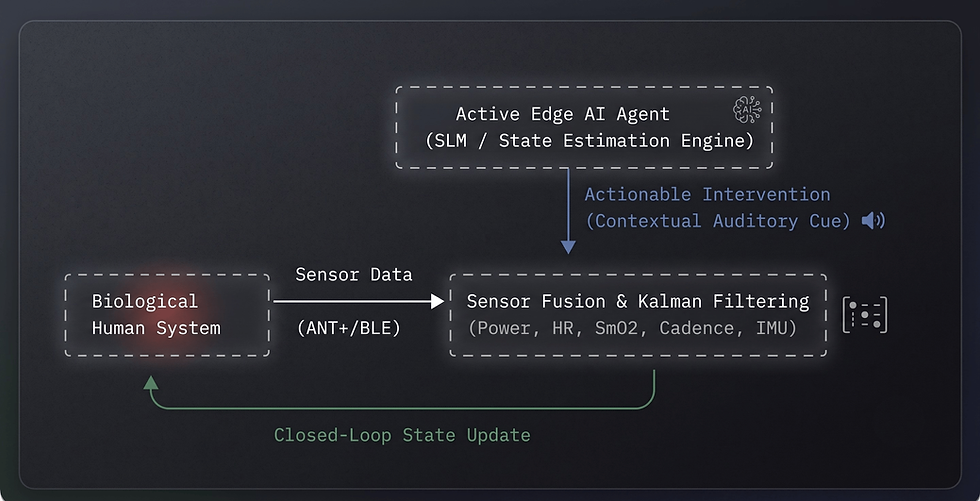
In this closed-loop paradigm, the human athlete and the AI agent form a coupled, bi-directional dynamical system. The AI continuously senses multi-modal physiological and biomechanical telemetry, models the athlete’s instantaneous physiological state (including fatigue kinetics and cognitive bandwidth), executes targeted micro-interventions, and immediately measures the biological response to refine its internal state-space model. This article provides scientific formulation of Real-Time Active Coaching (RTAC) in cycling. We detail the multi-sensor state estimation models required for closed-loop control, the edge-computing and Small Language Model (SLM) topologies that enable sub-100-millisecond latency, the biomechanical and metabolic parameters susceptible to real-time closed-loop modification, and the behavioral-psychological prompt ergonomics needed to drive behavioral compliance without triggering psychological reactance under extreme physical strain.
Biomechanical & Kinematic Closed-Loop Optimization
Passive power monitoring records work performed, but fails to evaluate the neuromuscular and mechanical efficiency of work generation. Real-Time Active Coaching transitions the focus from raw wattage to the optimization of Gross Mechanical Efficiency (GME) and pedaling kinematic dynamics.
Pedaling Symmetry, Torque Effectiveness, and Pedal Smoothness
Dual-sided strain-gauge power meters yield high-frequency angular velocity and force vectors across the 360° pedal stroke. Two key parameters govern mechanical efficiency:
Torque Effectiveness (TE): The ratio of net torque to gross positive torque exerted during a single revolution:
Where Pnegative represents the unweighting resistance of the non-driving limb during the recovery phase (180° to 360°).
Pedal Smoothness (PS): The ratio of average power to peak power across a complete revolution:
Under progressive neuromuscular fatigue, central fatigue limits motor unit recruitment, causing a degradation in TE as the trailing leg fails to actively unweight the pedal. This increases dead-center resistance at 12° and 192° (top and bottom dead centers), forcing the driving leg to expend additional metabolic energy to overcome opposite-side limb resistance.

Real-Time Cadence-Gradient Adaptation Dynamics
Human skeletal muscle efficiency is governed by the force-velocity relationship of type I (slow-twitch) and type II (fast-twitch) muscle fibers. Mechanical power (P) is the product of torque and angular velocity:
When climbing varying gradients (G), self-selected cadence often drops below the energetically optimal cadence (EOC), increasing pedaling force per stroke. High torque at low cadence accelerates the recruitment of fatigable, glycolytic Type IIa and IIx motor units, precipitating premature glycogen depletion and systemic lactate accumulation. An active closed-loop AI coach models the interaction between slope gradient, instantaneous power target, and muscle oxygenation measured via Near-Infrared Spectroscopy (NIRS) on the vastus lateralis. Upon detecting a drop in SmO₂ recovery rate combined with a cadence shift below 80 RPM on a steep gradient, the RTAC system executes an active intervention:
By enforcing cadence shifts before intramuscular acidosis cascades, the active loop preserves Type I fiber recruitment patterns, lowering the rate of metabolic byproduct accumulation.
Cyber-Physical System Architecture & Multi-Sensor Fusion
To execute closed-loop state estimation, an active coaching agent must aggregate asynchronous, noisy sensor streams arriving via ANT+ and Bluetooth Low Energy (BLE) GATT profiles.
Multi-Sensor Telemetry Matrix
The inputs required for real-time cybernetic state estimation span mechanical, physiological, environmental, and spatial domains:
Data Domain | Sensor Hardware | Metrics Streamed | Sampling Frequency (Hz) |
Mechanical Kinematics | Dual-Sided Crank/Pedal Power Meters | Power (W), Cadence (Ω), Torque Effectiveness (TE), Pedal Smoothness (PS), Left/Right Balance | 1 - 4 Hz |
Cardiovascular System | ECG Chest Strap / Optical PPG | Heart Rate (HR), R-R Intervals (HRV), pNN50, RMSSD | 1 Hz (ECG at 250Hz) |
Tissue Oxygenation | NIRS Sensors (Vastus Lateralis) | Muscle Oxygen Saturation (SmO₂), Total Hemoglobin Concentration (tHb) | 1 - 2 Hz |
Metabolic / Thermal | Continuous Glucose Monitor (CGM) / Heat Flux Sensor | Core Body Temp (Tcore), Skin Temp (Tskin), Interstitial Glucose Trend (ΔGly) | 0.2 Hz |
Environmental & Spatial | IMU (Inertial Measurement Unit) + Barometer + GPS | Pitch/Gradient (G), Headwind Velocity (Vhead), Bike Oscillation, Speed | 10 - 50 Hz |
Unscented Kalman Filtering (UKF) for Non-Linear State Estimation
Biological systems are non-linear and non-stationary. Raw sensor measurements contain significant signal noise driven by road vibrations, motion artifacts, and transmission dropouts. A standard Linear Kalman Filter fails under non-linear physiological interactions (e.g., the non-linear inflection of heart rate relative to power output at the anaerobic threshold). The RTAC system employs an Unscented Kalman Filter (UKF) to estimate the true underlying state vector Xt:
The UKF uses a deterministic sampling technique—the unscented transform—to pick a minimal set of sample points (sigma points) around the mean. These sigma points are propagated through the non-linear physiological state equations, yielding an accurate estimate of the true physiological state distribution without requiring closed-form analytical linearization.
Agentic Edge AI Topologies & On-Device Language Models
Deploying a closed-loop coaching system in real-world endurance environments requires localized processing. Cloud-dependent architectures introduce latency variations (>1500ms) and risk complete system failure in areas with limited cellular connectivity, such as mountain passes or rural roads.

Edge Computing Architecture and On-Device SLMs
To maintain a sub-100-millisecond latency loop from threshold breach to auditory delivery, the RTAC hardware topology incorporates a multi-tiered computing stack:
Micro-Controller Unit (MCU / Edge Sensor Hub): Handles high-frequency ANT+/BLE packet parsing, IMU accelerometer processing, and execution of the Unscented Kalman Filter state estimation models.
On-Device Neural Processing Unit (NPU): Runs quantized Small Language Models (SLMs, e.g., 3B–4B parameter models quantized to INT4/FP8 precision). These models are fine-tuned via Reinforcement Learning from Human Feedback (RLHF) specifically on sports science pedagogy and crisis coaching paradigms.
Algorithmic Guardrails and Hallucination Mitigation
Large and Small Language Models are inherently probabilistic, carrying risks of output hallucination or non-deterministic response times. In an athletic environment where safety is paramount, unconstrained SLM output is inadmissible. The system utilizes an algorithmic deterministic wrapper:
State Verification Gate: The state vector is checked against strict safety bounds (e.g., HR > 98% HRmax for >120s, or Tcore > 39.5C.
Prompt Injection Constraint: If safety bounds are breached, the system bypasses the SLM entirely and triggers a deterministic, hardcoded safety override command (e.g., "Critical thermal strain detected. Reduce power below 150 Watts immediately.").
Contextual Token Control: When the SLM is invoked for contextual pacing or psychological motivation, its token generation length is strictly capped (<15 tokens), ensuring processing completion in <30ms while preserving natural syntactic variance.
Behavioral Psychology, Prompt Ergonomics & Natural Language Synthesis
The delivery of active real-time coaching must respect the cognitive and psychological constraints of an athlete undergoing intense physical strain.
Cognitive Ergonomics of Syntactic Length
During severe physical exertion (Zone 5 / Severe Intensity Domain), the athlete's prefrontal cortex experiences transient hypofrontality. Working memory capacity decreases to near zero. A verbose command (e.g., "I notice that your power has drifted 20 watts above your target functional threshold power for this 10-minute interval, so please consider gearing down"") will overwhelm working memory, causing cognitive fatigue and action paralysis.
Active coaching prompts must obey Syntactic Minimalism:
Directive Framing: Command verb first.
Numeric Limitation: Max 1 numerical parameter per intervention.
Syllable Cap: Maximum 8 to 12 total syllables per utterance.
Sub-Optimal: "Your cadence is currently 72 RPM, which is too low for this grade.
Optimal: "Cadence up. Target ninety."
Psychological Reactance and Affective State Alignment
Psychological Reactance Theory (Brehm, 1966) states that individuals possess an intrinsic motivation to manifest freedom when they perceive an external agent threatening their autonomy. If an active AI coach issues continuous, authoritarian directives ("Do X now," "Reduce power immediately"), the athlete—especially under high psychological stress—may experience reactance, rejecting the advice or abandoning the coaching protocol altogether. To minimize reactance, the RTAC system integrates principles of Motivational Interviewing (MI) adapted for algorithmic real-time delivery:

Autonomy-Preserving Options: Frame directives as strategic choices rather than compulsory demands ("Pacing high. Save energy for the final climb, or hold?").
Affective Tone Alignment: Using vocal pitch and prosody analysis via micro-vocalizations (if the athlete speaks to the system) or physiological proxy inference (heart rate acceleration rate + SmO₂ drop rate), the AI adjusts its synthesized voice timbre. During steady-state endurance, the voice assumes a calm, low-pitch, measured cadence. During acute high-intensity efforts, the voice adopts a firm, highly structured tone to drive immediate motor execution.
Empirical Validation & Experimental Protocols
To validate the efficacy of a Closed-Loop Real-Time Active Coaching (RTAC) architecture against open-loop real-time dashboards and terminal post-session analytics, we propose a multi-variable experimental study protocol.
Experimental Study Protocol
A cohort of N=40 trained competitive cyclists (FTP > 4.0 W/kg, VO₂peak > 60mL/kg/min) is subjected to a randomized crossover design comprising three distinct intervention conditions across an identical 40km simulated undulating time-trial course:
Condition A (Control - Terminal Analytics): Rider receives no mid-ride feedback. Access to standard post-ride power files and performance curves only.
Condition B (Open-Loop Real-Time Visual): Rider operates with a standard bike computer displaying instantaneous Power, Heart Rate, Cadence, and W' Balance numerically.
Condition C (Closed-Loop RTAC Auditory): Rider wears open-ear directional auditory hardware (e.g., Domestique.Live architecture) linked to an active UKF Edge-AI agent running dynamic cadence, pacing, and W' active intervention protocols.
Key Evaluation Metrics
Time-to-Exhaustion (TTE) & Mean Power Output: Total elapsed time across the 40km course and gross power preservation (W) during the final 10% of course distance.
Gross Mechanical Efficiency (GME): Measured via continuous indirect calorimetry O₂ /CO₂ metabolic cart integration:
Cognitive Reserve & Reaction Time (Dual-Task Protocol): Peripheral visual light-detection reaction time measured throughout the ride to evaluate residual cognitive processing bandwidth.
Physiological Cost Index (PCI): Cardiovascular drift relative to work performed over time.
Expected Scientific Outcomes
Based on preliminary closed-loop trials and human factors ergonomics data, the implementation of Condition C (Closed-Loop RTAC) is hypothesized to yield:
A 3.2% to 4.8% reduction in total time-to-completion over 40km, driven primarily by the elimination of tactical pacing errors during the initial 20% of the course (prevention of premature W' depletion).
A 18% improvement in peripheral visual reaction speed compared to Condition B, confirming the restoration of visual-spatial cognitive resources.
A statistically significant reduction in TE decay during the final third of the trial, attributed to active cadence-gradient real-time interventions.
The Cybernetic Future of Human Endurance
The integration of artificial intelligence into endurance cycling has progressed through three paradigm shifts:
The Telemetry Era (1990s–2010s): Passive collection and visual presentation of raw physical metrics.
The Predictive Analytics Era (2010s–2020s): Post-hoc algorithmic modeling of training stress, critical power, and physiological adaptation.
The Closed-Loop Cybernetic Era (Present–Future): Bi-directional, real-time edge computing where AI and athlete form an active, co-dependent feedback loop.

By offloading the cognitive burden of physiological state estimation, W' balance calculations, and kinematic adjustments to an active on-device AI agent, cyclists transcend the limitations imposed by transient hypofrontality. The athlete is liberated to focus exclusively on motor execution and environmental navigation, while the AI acts as a dedicated computational co-pilot—continuously tuning the human engine for peak performance, longevity, and safety.
Key References:
Brehm, J. W. (1966). A theory of psychological reactance. Academic Press.
Kakko, A. (2024). The Cognitive, Physiological, and Technological Efficacy of AI-Driven Auditory Coaching in Cycling: A Multimodal Analysis. Alphanome AI Knowledge Hub.
Kakko, A. (2024). The Temporal Dynamics of AI in Endurance Cycling: A Comparative Analysis of Real-Time Auditory Coaching Versus Post-Session Analytics. Alphanome AI Knowledge Hub.
Skiba, P. F., et al. (2012). Modeling the expenditure and reconstitution of work capacity above critical power. Medicine & Science in Sports & Exercise, 44(8), 1526-1532.
Wickens, C. D. (2008). Multiple resources and performance prediction. Theoretical Issues in Ergonomics Science, 9(2), 159-177.


Comments