Investor Analysis: The Active Coaching Category Paradigm

The human athletic performance software market is undergoing a structural paradigm shift driven by advancements in edge computing, wearable sensor fusion, and spatial bio-auditory interfaces. For over two decades, sports technology platforms have been temporally segregated into static pre-workout training planners and diagnostic post-workout analytics engines. While these incumbent categories successfully digitized workout scheduling and descriptive performance reviews, they suffer from an inherent architectural limitation: an inability to dynamically intervene during the actual execution phase of physical effort. Active Coaching represents a distinct software and hardware investment category within human-computer interaction (HCI) and sports technology. Defined by closed-loop, real-time cybernetic feedback, Active Coaching systems continuously ingest biometric telemetry, environmental physics, and spatial hazard data to deliver instantaneous auditory directives to athletes mid-effort. By closing the loop during exercise rather than hours later, this emerging category solves chronic real-world challenges including micro-pacing failures, premature bioenergetic depletion, dangerous visual distraction, and vulnerable road user safety hazards. From a venture capital perspective, Active Coaching represents a compelling growth frontier at the convergence of Artificial Intelligence, wearable technology, and human endurance optimization. The global AI in sports market—valued between $10.6 billion and $10.82 billion in 2025—is projected to reach up to $70.16 billion by 2035, growing at a compound annual growth rate (CAGR) exceeding 20%. Platforms in the Active Coaching category are positioned to capture high-margin software subscriptions and enterprise licensing revenues by replacing passive tracking tools with indispensable, real-time active guidance ecosystems.

1. Macro Market Dynamics and The Temporal Triad of Sports Technology
To evaluate the venture opportunity within Active Coaching, institutional investors must analyze the temporal mechanics and structural shortcomings of legacy athletic software frameworks. The market is historically divided across a temporal continuum, leaving a high-value operational gap during execution.

Pre-Workout Planning Software
Legacy pre-ride and pre-workout applications—such as TrainingPeaks, Join.cc, and Zwift—operate exclusively on macro-temporal, static planning loops. These platforms analyze historical training stress metrics to generate calendar-based workout plans days or weeks in advance. However, these plans are completely deterministic. When an athlete encounters real-world environmental variables—such as an unexpected 30 km/h headwind, dense urban traffic grids, sudden heat stress, or unmapped steep gradients—the pre-programmed targets become biologically inaccurate or physically unsustainable. These applications possess no technical mechanism to dynamically recalibrate target intensity during the ride based on real-time physiological strain or ambient environmental resistance.
Post-Workout Analytics Engines
Diagnostic platforms such as Strava and Intervals.icu operate on a lagging post-facto basis. These software engines ingest recorded telemetry files (such as FIT or TCX files) to display post-hoc charts, red-line exhaustion curves, and chronic fatigue indexes. While valuable for macro-level periodization and social engagement, post-workout analytics deliver zero operational utility during the execution window. A red chart displayed two hours after a training session explaining that a cyclist depleted their anaerobic capacity on an early climb serves purely as a post-mortem diagnostic. It offers no operational capability to prevent pacing errors while the athlete is actively pedaling.
Active Coaching Platforms
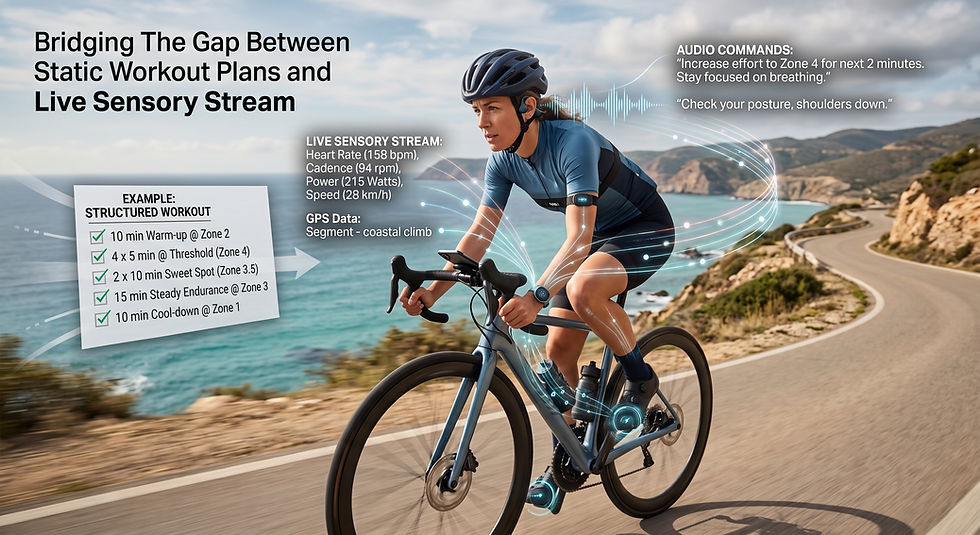
Active Coaching bridges this execution gap by deploying closed-loop cybernetic feedback loops directly within the activity window. Pioneered in endurance cycling by platforms such as Domestique.live, Active Coaching engines integrate live biometric streams—including dynamic power output, heart rate variability, cadence, and core temperature—with spatial audio guidance and predictive bioenergetic models. Rather than forcing the athlete to interpret visual numbers on a bike computer screen, the application functions as an algorithmic sports director, issuing real-time micro-verbal directives directly into an open-ear audio interface to optimize energy management, preserve anaerobic reserves, and enforce tactical focus.
Feature Rationale | Pre-Workout Planning (e.g., TrainingPeaks, Zwift) | Post-Workout Analytics (e.g., Strava, Intervals.icu) | Active Coaching Platforms (e.g., Domestique.live) |
Temporal Dynamic | Macro-temporal (Pre-effort planning) | Macro-temporal (Post-effort diagnostics) | Micro-temporal (Continuous real-time intervention) |
Primary Data Input | Historical load metrics & target calendars | Recorded FIT/TCX files & sensor logs | Live multi-sensor fusion (Power, HR, GPS, ADAS) |
User Interaction | Visual screen inspection prior to activity | Visual chart analysis post-activity | Spoken micro-directives via open-ear audio |
Environmental Adaptability | Zero dynamic response to headwinds/traffic | Zero real-time response capability | Continuous recalibration to slope, wind, and traffic |
Cognitive Load | Low (Static preparation phase) | Low (Resting analytical phase) | Minimal (Offloads visual task-switching) |
Primary Value Capture | Structured workout generation | Social sharing & post-hoc diagnostics | Real-time performance optimization & safety |
2. Cybernetic Architecture: Closed-Loop Sensor Fusion and Bioenergetic Modeling
The architectural foundation of an Active Coaching engine is rooted in closed-loop cybernetic theory. Unlike open-loop systems where operational output is independent of system state, cybernetic intelligence creates an unbroken, continuous loop of multi-sensor sensing, edge processing, real-time intervention, physiological response measurement, and dynamic re-calibration.

Edge Computing and Multi-Sensor Data Aggregation
To deliver sub-second coaching interventions without relying on unstable cellular cloud connectivity, Active Coaching platforms execute multi-sensor fusion locally at the device edge. The edge application layer ingests concurrent data streams via low-energy wireless protocols (ANT+ and Bluetooth Low Energy), continuously unifying multiple operational inputs:
Kinematic and Kinetic Stream: Dynamic power output, torque effectiveness, pedal stroke smoothness, and cadence.
Cardiovascular and Metabolic Stream: Continuous heart rate variability (HRV), systemic strain indexes, and core body temperature monitoring.
Environmental Drag Vector: Barometric elevation changes, real-time GPS slope gradients, ambient temperature, and external wind vectors.
Spatial Radar Telemetry: Millimeter-wave radar data monitoring trailing vehicle trajectories and approaching closing speeds.
Real-Time Energy Reserve Management (W' Balance Dynamics)
A foundational technical breakthrough of Active Coaching in endurance sports is the real-time tracking and management of Anaerobic Work Capacity, known as W' Balance (measured in Joules). Critical Power represents the maximum continuous power output an athlete can sustain without accumulating rapid metabolic fatigue. When an athlete exceeds their Critical Power threshold, they draw directly from their finite anaerobic energy tank (W'). Rather than relying on static post-workout charts, Active Coaching engines run continuous bioenergetic models at the edge. The system constantly calculates the rate at which anaerobic reserves are being spent during intense surges, as well as the non-linear rate at which those reserves recover when exertion drops back below Critical Power. In conventional setups, an athlete surging up an unmapped grade has no visibility into their remaining anaerobic capacity until severe muscle failure occurs. An Active Coaching engine calculating these bioenergetic dynamics detects when a prolonged effort threatens to drain the athlete's energy reserves below a critical safety threshold (such as falling below 20% of remaining capacity). The system immediately synthesizes an auditory micro-directive—such as "Surge detected. Ease power by 35 Watts for 45 seconds to preserve anaerobic tank for the crest." This active intervention prevents catastrophic bioenergetic depletion in real time.
3. Attentional Ergonomics and Neuro-Psychological Foundations
The design of human-computer interaction in high-velocity, physically demanding environments governs both athletic performance and physical safety. Active Coaching shifts user interaction from visual screen checking to hands-free auditory processing.
Cognitive Overload and Visual Channel Saturation
Under high physical exertion, an athlete's cognitive bandwidth experiences severe narrowing, frequently inducing perceptual tunneling. Legacy bike computers, smartwatches, and visual heads-up displays rely on visual task-switching. To read a target power range or monitor heart rate zones on a stem-mounted display, a cyclist travelling at 45 km/h must lower their focal plane by 30 to 45 degrees, removing visual focus from the road for 1.5 to 2.5 seconds. At high speeds, this visual latency means traveling 20 to 30 meters entirely unblinded to road surface hazards, cornering lines, or sudden vehicular braking. Active Coaching applies attentional ergonomics by transferring data delivery from the visual cortex to the auditory processing system. Delivering concise verbal prompts eliminates visual task-switching, allowing the athlete's visual field to remain centered on spatial navigation and environmental awareness.
Micro-Directive Tone Engineering and Agency Dynamics
The neuro-psychological adoption of algorithmic guidance depends heavily on directive phrasing, temporal frequency, and cognitive ergonomics. Excessive, verbose, or improperly timed audio alerts induce listener fatigue, frustration, and software abandonment. Active Coaching systems utilize micro-directive tone engineering, deploying short-form imperative phrasing designed to minimize cognitive processing overhead:
Sub-Optimal Verbose Phrasing: "You are currently producing 340 Watts, which is 40 Watts above your target threshold for this interval. Please reduce your pedaling effort and lower your cadence." (High cognitive processing time; ~4.5 seconds execution window).
Optimized Micro-Directive: "Power high. Ease 40 Watts. Cadence 90." (Low cognitive processing time; ~0.8 seconds execution window).
Furthermore, the system balances automated direction with human agency. Rather than issuing rigid commands that conflict with athlete intuition, the software frames interventions around predictive bioenergetic outcomes, maintaining the athlete's psychological sense of autonomy while optimizing power output.
4. Hardware Safety Integration: Wearable ADAS and Vulnerable Road User Protection
A major barrier to outdoor athletic training adoption is road safety. Active Coaching platforms directly address this issue by synthesizing real-time performance optimization with Wearable Advanced Driver Assistance Systems (ADAS).

The Vulnerability Gap and the Silent Electric Vehicle (EV) Threat
While passenger car occupant safety has improved significantly due to integrated vehicular ADAS, vulnerable road user (VRU) mortality—specifically among cyclists and outdoor runners—remains high. In the European Union, cyclist fatalities dropped by only 8% over a ten-year evaluation period. This hazard is magnified by the rapid adoption of Electric Vehicles (EVs). Because EVs operate silently at low speeds and are only legally mandated to emit Acoustic Vehicle Alerting Systems (AVAS) up to 20 km/h, high-speed EV approaches on rural or suburban roads leave cyclists with a compressed reaction window of only 1 to 2 seconds. Human auditory detection fails to consistently identify fast-approaching silent EVs in wind-heavy outdoor environments.
Hardware Architecture: Open-Ear Design and Zero Physical Occlusion
To maintain regulatory safety compliance, certified Active Coaching platforms mandate open-ear hardware architectures, such as bone-conduction transducers or directional air-conduction speakers. This structural constraint guarantees zero physical occlusion of the ear canal, ensuring 100% of natural ambient environmental sounds—including sirens, approaching engines, and verbal warnings—reach the athlete unattenuated.
Safety-First Firmware and Audio-Ducking Protocols
Active Coaching platforms integrate safety data directly into the execution loop by processing millimeter-wave radar inputs and acoustic recognition algorithms. The hardware firmware incorporates a hardcoded priority architecture where critical safety alerts override all performance coaching directives:
Concurrent Sensor Processing: The edge engine continuously processes biometric performance data alongside spatial hazard telemetry.
Instantaneous Audio-Ducking Protocol: The millisecond a trailing vehicle exhibits an alarming closing velocity or dangerous trajectory, the firmware triggers an automated audio-ducking protocol, instantly muting active coaching directives, music, or navigation prompts.
Directional Spatial Audio Warning: The system broadcasts an immediate spatial auditory alert directly into the athlete's open-ear headset (e.g., "Vehicle approaching fast, rear left"), expanding the athlete's safety reaction window from 1.5 seconds to over 5 seconds.
5. Case Study: Domestique.live and Cycling Market Operations
The operational mechanics of Active Coaching are clearly demonstrated by Domestique.live, an emerging platform pioneering real-time voice guidance for endurance cyclists.

Dynamic Environmental Recalibration vs. Static Workout Execution
The real-world operational divergence between legacy planning software and Domestique.live's Active Coaching architecture is illustrated in standard endurance training scenarios:
Standard Execution Under Legacy Tools (TrainingPeaks / Garmin): An athlete embarks on a structured interval session targeting 300 Watts for 15 minutes. Halfway through the interval, the cyclist encounters an unmapped 35 km/h headwind while the incline increases from 3% to 8%. Lacking real-time feedback, the cyclist instinctively surges to 380 Watts to maintain visual ground speed, unknowingly depleting their anaerobic reserve (W'). Two hours later, Strava renders a post-ride chart showing severe threshold breakdown, explaining post-facto why the rider suffered complete fatigue during the final portion of the ride.
Dynamic Execution Under Domestique.live Active Coaching: Domestique.live ingests real-time changes in mechanical resistance, fusing incline metrics, power output, and wind vector modeling. Recognizing the dynamic increase in ambient drag, the platform's edge AI recalculates target parameters within 2 seconds. The athlete receives an immediate spoken instruction via open-ear audio: "Headwind increasing. Do not surge. Shift down one gear, drop power to 275 Watts, hold cadence at 92 RPM."
By dynamically regulating exertion during unexpected environmental changes, Domestique.live protects the athlete's W' balance, prevents premature metabolic failure, and ensures training objectives are met safely.
6. Horizontal Market Expansion: Cross-Sport Portfolio Synergy
While endurance cycling serves as an ideal technical proof of concept, the core Active Coaching paradigm—fusing multi-sensor telemetry with instantaneous auditory feedback—scales horizontally across major sport verticals.

Precision Sports: Golf Performance Dynamics
In golf, platforms such as the Uneekor AI Trainer demonstrate the application of active coaching to bio-mechanical movement. By fusing launch monitor data, optical computer vision, and high-speed motion sensors, the system analyzes clubhead trajectory, face angle at impact, and ball flight dynamics in real time. Rather than forcing the golfer to review video recordings after completing a swing session, the platform delivers instant voice coaching cues between practice swings, allowing for immediate adjustments to swing path and tempo.
Endurance Sports: Running Economy and Gait Dynamics
In running, Active Coaching systems integrate foot-pod inertial sensors (IMUs) and wearable heart rate monitors to track ground contact time asymmetry, vertical oscillation, stride rate, and cardiovascular drift. When cadence drops or vertical movement increases—indicating mechanical fatigue and increased joint stress—the audio coach issues real-time corrections (e.g., "Increase stride rate by 4 steps per minute to reduce knee load"), optimizing running economy and reducing injury risk.
Strength and Conditioning: Velocity-Based Training (VBT)
In high-performance weightlifting, computer vision and linear position sensors measure concentric barbell velocity. An Active Coaching engine tracks velocity loss across consecutive repetitions. When repetition speed drops by more than 20%—signaling acute central nervous system fatigue—the audio engine intervenes mid-set: "Rep speed down 22%. Rack the bar to avoid form breakdown." This real-time feedback optimizes strength adaptations while preventing fatigue-induced injuries.
Sport Vertical | Primary Sensor Suite | Real-Time Telemetry Input | Active Coaching Directive Output | Primary Risk / Bio-Benefit Mitigated |
Cycling | Power meter, HR, GPS, Rear Radar | Power, cadence, incline, W' balance, vehicle closing speed | Power target adjustment, gear/cadence prompts, spatial vehicle alerts | Prevents W' exhaustion, reduces vehicle collision risk |
Golf | Launch monitor, vision cameras, swing IMU | Clubhead path, face angle, tempo ratio, smash factor | Instant auditory cue on swing path modification mid-practice | Corrects swing mechanics in real time |
Running | Chest strap HR, foot pod IMU, GPS | Cadence, ground contact balance, vertical oscillation, HR drift | Stride cadence adjustment, real-time pace throttle prompts | Prevents biomechanical overload & fatigue-induced injury |
Strength Training | Computer vision, barbell VBT sensors | Concentric bar velocity, displacement path, set rep count | In-set termination alerts, bar-path trajectory correction | Prevents neurological overtraining & structural form failure |
Swimming | Bone-conduction IMU head unit | Stroke rate, turn push-off velocity, SWOLF efficiency index | Mid-lap stroke rate pacing cues, breath rhythm timing prompts | Maximizes hydro-dynamic efficiency & stroke mechanics |
7. Financial Forecasts, Unit Economics, and Venture Capital Roadmap
Evaluating Active Coaching as an asset class requires contextualizing the market within broader forecasts across sports technology, artificial intelligence, and digital coaching platforms.
Market Sizing and Growth Trajectories
Multiple market evaluation sources confirm expanding addressable markets across all underlying technology components:
Global AI in Sports Market: Valued between $10.6 billion and $10.82 billion in 2025. The market is projected to reach $12.7 billion to $13.1 billion in 2026, scaling to $33.32 billion by 2031, $49.9 billion by 2033, and reaching up to $70.16 billion by 2035. Forecasts indicate compound annual growth rates (CAGR) ranging from 20.56% to 27.85%.
Global Sports Technology Market: Valued at $32.36 billion in 2025. The overall market is projected to grow from $39.34 billion in 2026 to $200.83 billion by 2034, reflecting a 22.6% CAGR. Wearable hardware accounts for 31.8% of this total revenue.
Sports Coaching Platforms Market: Focused specifically on software platforms, the market reached $646.5 million to $656.5 million in 2025, and is projected to expand to $1.756 billion–$1.94 billion by 2034–2035 at an 11.39% to 11.45% CAGR.
Market Segment | 2025 Baseline | 2026 Estimate | Forecasted Target | Forecast Period | Projected CAGR | Primary Growth Drivers |
AI in Sports Market | $10.60B – $10.82B | $12.70B – $13.10B | $49.90B – $70.16B | 2026–2035 | 20.56% – 27.85% | Edge-AI multi-sensor fusion, predictive biomechanics |
Sports Tech Overall | $32.36B | $39.34B | $200.83B | 2026–2034 | 22.60% | Wearable tech (31.8% share), digital performance tracking |
Coaching Platforms | $646.5M – $656.5M | $720.0M (Est.) | $1.75B – $1.94B | 2026–2035 | 11.39% – 11.45% | Remote automated coaching, real-time alert systems |
Value Capture, Pricing Models, and Retention Economics
Active Coaching platforms achieve stronger unit economics than passive post-workout tracking apps due to their direct integration into active workouts. Three core monetization vectors define the market:
High-Margin Consumer SaaS Subscriptions: Monthly software subscriptions ranging from $15 to $30/month. Because real-time voice coaching becomes an integral component of the active training experience, customer churn is substantially lower than passive tracking tools.
Hardware-Software Ecosystem Bundles: High-margin recurring software subscriptions integrated with specialized open-ear audio hardware, radar units, or bio-sensing devices.
Enterprise B2B and Professional Team Licensing: Enterprise software licenses sold directly to professional sports teams, WorldTour cycling organizations, and national athletic federations for real-time workload management and tactical optimization.
Strategic Moats and Competitive Defensibility
For venture capital funds evaluating early-stage investments in Active Coaching, long-term defensibility relies on three key technical moats:
Proprietary Continuous Intervention Datasets: Legacy tracking apps record passive biometric logs, whereas Active Coaching engines capture proprietary intervention-response pairs—recording exactly how an athlete's physiology responds within seconds of receiving an auditory instruction. This closed-loop data asset continuously enhances model accuracy over time.
Low-Latency Edge Execution IP: Engineering proprietary algorithms capable of executing real-time W' balance calculations, spatial hazard detection, and audio-ducking entirely on-device without cloud latency.
Safety Certification and Hardware Integrations: Deep firmware integration with radar hardware, acoustic sensors, and open-ear safety standards establishes significant technical barriers to entry for late market entrants.
8. Strategic Conclusions and Investment Roadmap
The transition from static post-workout analysis to closed-loop real-time active guidance represents a major evolution in athletic software architecture. By addressing the operational gap during execution, platforms like Domestique.live establish a high-margin, highly defensible category within the expanding sports technology ecosystem. Venture capital investors evaluating opportunities within the Active Coaching domain should prioritize startups demonstrating four core competencies:
True Closed-Loop Architecture: Software systems capable of making real-time, automated adjustments to athletic targets mid-effort, rather than issuing generic post-workout feedback.
Human-Centric Attentional Ergonomics: Product implementations centered on low-latency open-ear auditory guidance that eliminate visual distraction.
Integrated Safety & ADAS Capabilities: Edge firmware architectures that prioritize spatial safety alerts and audio-ducking over performance directives.
Cross-Sport Platform Scalability: Modular data architectures capable of expanding beyond initial endurance sports into high-value verticals such as golf, running, and strength training.
As wearable sensor accuracy, edge computing capacity, and spatial audio hardware continue to advance, Active Coaching is positioned to capture significant market share, establishing the benchmark for next-generation human performance platforms.



Comments