The Static FIT-File Paradox: Closing the Loop Between Static Prescriptions and Real-Time Adaptive Execution

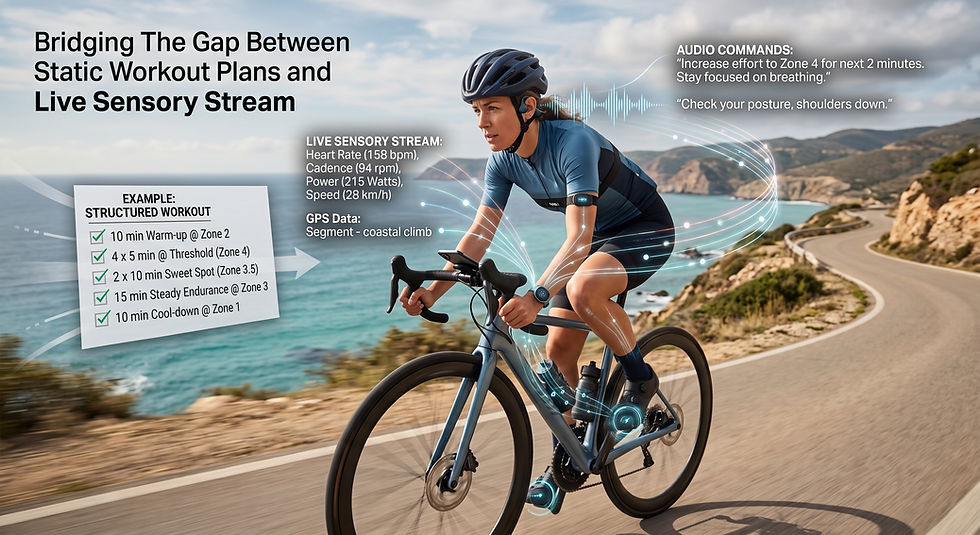
In our previous article, Bridging the Gap Between Static Workout Plans and Live Sensory Stream, we explored how a real-time rule engine transforms raw sensor streams—power, heart rate, cadence—into timely, actionable audio feedback. We addressed real-time signal processing, including power smoothing, heart rate lag grace windows, and environmental override logic for real-world riding conditions.
However, examining structured coach-prescribed workout files across various training phases reveals a deeper systemic limitation: Standard workout files (.FIT, .ERG, .ZWO) are lossy representations of overall coaching intent.
A standard workout file flattens a nuanced training prescription into rigid time-and-target blocks. It instructs head units on target intensity zones, but lacks the conditional logic required to adapt when real-time human physiology diverges from the theoretical plan.

1. The Architectural Anatomy of Missing Workout Metadata
Regardless of the specific workout type, analyzing standard step arrays highlights five key structural dimensions where static representations fail:
A. Transition Slew-Rate Intent (Target Onset Profile)
In micro-intervals or high-intensity surges, step boundaries are represented as instantaneous vertical leaps (e.g., jumping from 50% to 150% FTP in 0 seconds). Static file formats carry no slew-rate metadata. Is the objective an explosive torque spike to maximize High-Threshold Motor Unit (HTMU) recruitment, or a progressive ramp to avoid premature anaerobic glycolytic buildup?
B. Autonomic Strain & In-Session Volume Scaling
High-intensity interval sets aim to accumulate time near maximal aerobic capacity (VO₂max). If an athlete experiences severe cardiac drift or acute fatigue during an intermediate set, continuing through hard-coded remaining repetitions causes non-functional overreaching. Static files lack failure criteria to prematurely truncate sets, cap interval volume, or convert remaining work into aerobic recovery.
C. Adaptive Recovery-Driven Micro-Intervals
Standard workout files allocate fixed rest durations between hard efforts. However, physiological readiness during interval work depends on autonomic recovery speed. Rest steps should dynamically contract or expand based on real-time physiological clearance (e.g., holding rest until Heart Rate drops below the first ventilatory threshold, VT₁).
D. Multi-Metric Decoupling & Target Fallback Strategy
Workouts are typically bound to a single primary target metric—Power or Heart Rate. Extended efforts induce cardiovascular drift due to dehydration, ambient heat, and autonomic fatigue. Bounding execution strictly to target Power forces Heart Rate into unsustainable metabolic zones; bounding strictly to Heart Rate causes Power output to collapse unexpectedly.
E. Environmental & Cadence-Torque Adaptation
Static workout files ignore environmental realities such as gradient shifts, sharp corners, or stoplights. Furthermore, target power of 300W at 60 RPM places vastly different neuromuscular stress on the musculoskeletal system than 300W at 100 RPM. Static files lack embedded cadence-torque profiles, leaving the engine blind to fatigue caused by low-cadence grinding.
2. Deep Dive: Biomechanics, Autonomic Readiness, and Signal Architecture
A. Biomechanical Efficiency & Cadence-Torque Dynamics
Standard execution engines treat power as a scalar value (P = τ ⋅ ω). However, neuromuscular fatigue is dictated by joint angular velocity (ω) and effective pedal force (τ). When an athlete grinds at low cadence (<70 RPM), force per pedal stroke skyrockets, accelerating fast-twitch muscle fiber glycogen depletion even if target power remains within compliance. An adaptive engine continuously monitors cadence-torque vectors to cue gear adjustments before neuromuscular failure occurs.
B. Biological Noise vs. Systemic Strain Signals
Real-time sensor data is inherently noisy. A sudden heart rate spike could reflect cardiac drift, thermal strain, dehydration, or simply a temporary artifact from a bumpy road surface. To prevent unnecessary overrides, the adaptive system applies dual-window moving averages and autonomic grace windows:
C. Environmental & Terrain Override Layer
Outdoor execution requires real-time reconciliation between structured steps and topographic conditions. If an athlete hits a steep downhill segment during a high-power interval, attempting to hold target power creates dangerous riding conditions. The adaptive engine introduces terrain-aware fallback states, shifting interval triggers or pausing target timers until grade and safety conditions permit execution.
3. The Adaptive Execution State Machine
To bridge the gap between static files and real-time execution, an intelligent audio co-pilot engine must evolve beyond basic compliance matching (At = Pt) into a multi-state decision machine.
State Transition Logic & Dynamic Recovery Gates
4. General Telemetry to Adaptive Action Matrix
Workout Class | Detected Telemetry Anomaly | Engine State Action | Dynamic Audio Coaching Prompt |
High-Intensity Intervals
| Cadence drops below threshold (< 70 RPM) while Power drops below target | Fatigue-induced grinding detected mid-effort | "Cadence dropping. Downshift two gears and increase RPM." |
Intermittent Bursts
| HR fails to recover below aerobic threshold (VT₁) during rest step | Dynamic Rest Extension (adds 30s recovery window) | "Heart rate elevated. Extending recovery window." |
Steady Aerobic / Base
| Power is on target, but HR exceeds upper aerobic limit (VT₁) | Power target override; cap effort by Heart Rate ceiling | "Thermal strain high. Easing power target by 10%." |
Low-Intensity Recovery
| Power spikes above Zone 2 ceiling on short climbs or accelerations | Instantaneous Zone Enforcer trigger | "Effort spiking on climb. Soft pedal to stay in Zone 1." |
Mixed Terrain Riding | Downhill grade drops below -4% during threshold step | Terrain Safety Override; pause step execution | "Steep downhill. Pausing step until flat road." |
From Static Scripting to Intelligent Co-Pilot Coach
Static workout files serve as effective initial blueprints, but they are insufficient as real-time execution scripts. By expanding real-time execution software to interpret implicit coaching intent—managing transition rates, dynamic recovery windows, cadence-torque mechanics, and environmental factors—we shift athletic guidance from passive file playback to an active, real-time co-pilot coach.




Comments