The Inevitable Trap: How Game Theory Drives the Global AI Race

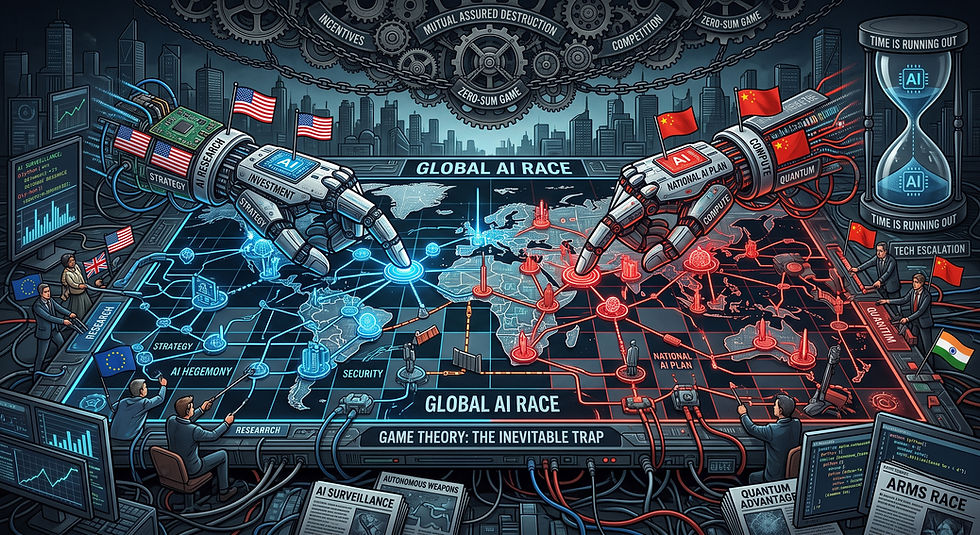
In Cold War parlance, global security was governed by Mutual Assured Destruction—a terrifying equilibrium sustained by the certainty that pressing the nuclear button meant total annihilation. Today, inside the hum of climate-controlled server facilities spanning Silicon Valley, Beijing, and beyond, a different kind of arms race is taking shape. It moves not with the thunderous launch of intercontinental ballistic missiles, but with the quiet, exponential scaling of floating-point matrix operations across multi-gigawatt compute clusters. The global competition to build frontier artificial intelligence has long surpassed the realm of corporate innovation and venture-backed speculation. It has matured into a defining geopolitical struggle—one dictated by the cold, mathematical logic of game theory's most famous paradox: The Prisoner’s Dilemma.
The Strategic Calculus of Mutual Defection
To understand why calls for voluntary pauses, safety evaluations, or international moratoriums repeatedly stall, one must map the structural incentives confronting nation-states and technological hyperscalers alike.
Imagine two competing sovereign powers—Nation A and Nation B. Both stand before the horizon of transformative artificial intelligence. Both acknowledge that deploying increasingly autonomous, multi-agent frontier models carries existential risks: software misalignments, catastrophic automated cyber capabilities, socioeconomic shocks, and the erosion of human command over critical defense architecture.
If both nations agree to slow down, enforce stringent safety evaluations, and prioritize governance over raw capability scaling, both secure a stable, manageable transition. This represents the optimal collective outcome—a classic win-win.
Yet, behind closed doors, the strategic calculus reveals a stark imbalance:
If Nation B Cooperates (slows development and adds safeguards), Nation A’s dominant move is to Defect (accelerate capabilities). By sprinting ahead, Nation A secures absolute technological supremacy, establishes permanent market moats, and renders Nation B strategically and economically vulnerable.
If Nation B Defects (pushes capability boundaries at all costs), Nation A’s only rational move is to Defect as well. Pausing while a strategic rival achieves breakthrough general intelligence is viewed as an unacceptable surrender of national sovereignty.
Regardless of the choice made by the opponent, the single optimal strategy for each individual player is to press the accelerator to the floor. They arrive inevitably at the bottom-right quadrant of game theory's payoff matrix: mutual, high-risk acceleration into systemic instability.
Centralized Hegemony vs. Open Access
The Prisoner’s Dilemma does not exist solely between rival nations; it also divides society internally over how frontier AI power should be distributed. This manifests as a fundamental clash between Centralized Gatekeeping and Universal Open Access.
The Case for Centralized Control
Advocates for centralized containment—often leading frontier labs, state security agencies, and regulatory bodies—argue that sovereign-tier AI is too dangerous to democratize freely.
Proliferation Risks: If raw weights for autonomous models capable of discovering pathogen synthesis steps or generating sophisticated zero-day exploits are released openly, bad actors can deploy them without safety filters.
Inspectable Safety Standards: A centralized ecosystem—where a small coalition of vetted corporations host models behind secure API endpoints—allows governments to monitor usage, enforce alignment guardrails, and implement instant circuit-breakers if dangerous behaviors emerge.
The Case for Universal Open Access
Conversely, open-source advocates, independent researchers, and sovereign nations outside the primary tech hubs argue that centralization creates an authoritarian monopoly over human knowledge.
Preventing Ideological Monopolies: Concentrating frontier intelligence within a handful of Western hyperscalers or state-sanctioned monopolies hands unprecedented power to private boardrooms to censor information, shape cultural narratives, and determine economic access.
Equitable Economic Scaling: If AI becomes the core engine of scientific discovery and economic productivity, centralizing it behind corporate paywalls creates a digital feudalism where developing nations and independent researchers are permanently dependent on tech cartels.
Security Through Transparency: Open-access models democratize defensive capabilities. When code and model architectures are open, millions of global developers can identify vulnerabilities, build defensive patches, and audit hidden biases faster than any centralized team.
The Democratization Dilemma
This debate presents its own game-theoretic trap: If a benevolent lab refrains from open-sourcing a model to prevent misuse, an unrestricted actor will open-source theirs anyway, capturing global developer ecosystems while proliferating the very risks the first lab sought to contain.
Why Silicon Defies Historical Arms Control
Geopolitical analysts frequently cite historic treaties—such as the 1968 Nuclear Non-Proliferation Treaty (NPT) or the 1972 Anti-Ballistic Missile Treaty—as evidence that sovereign rivals can constrain dangerous capabilities. However, artificial intelligence possesses unique characteristics that render conventional arms control regimes ineffective.
The Problem of Intangible Weights
Nuclear warheads require heavy physical infrastructure: enrichment centrifuges, specialized reactors, and launch vehicles that emit detectable thermal and radiation signatures observable via satellite imagery. A frontier AI model, once trained, exists as a file of digital weights—trillions of floating-point parameters that can be compressed, encrypted, and duplicated across global networks in seconds.
Dual-Use Fluidity
Unlike plutonium, which has limited utility outside power generation and weaponry, frontier software architecture is inherently dual-use. The same foundational model that optimizes medical research or automates software engineering can be fine-tuned overnight to discover novel biological agents or orchestrate autonomous drone swarm tactics.
Private Sector Velocity
The Manhattan Project was an exclusively state-controlled enterprise conducted under military secrecy. Modern AI frontier research is largely propelled by publicly traded corporations and private labs competing in hyper-capitalized markets. For a tech company, lagging six months behind a rival's model release can mean losing developer lock-in, talent, and hundreds of billions of dollars in enterprise valuation.
The Accelerating Drivers: Efficiency vs. Brute-Force Scaling
The dynamics of the AI Prisoner's Dilemma are further complicated by diverging strategic paradigms between major global actors:
Compute Dominance (The Brute-Force Frontier): Leading Western labs rely on massive capital expenditure, scaling laws, and access to gigawatt-scale data center capacity. The goal is to out-compute rivals by pushing raw parameters and reasoning tokens to new extremes.
Algorithmic Distillation (The Efficiency Counter-Strategy): Competitors facing chip export controls have pivoted toward algorithmic distillation, architecture optimization, and open-weights distillation. By taking frontier output from leading models and using it to train smaller, hyper-efficient systems, rivals can achieve near-parity capabilities at a fraction of the original training cost.
This dynamic creates a secondary dilemma: restricting hardware access does not guarantee a pause in capability gains, as algorithmic breakthroughs continually lower the compute threshold required to build dangerous software capabilities.
Breaking the Paradox: A Physical Governance Framework
If unconstrained game theory dictates mutual escalation, how can humanity escape a catastrophic outcome? The answer lies in shifting the paradigm from software inspection to hardware monitoring. While software parameters are intangible, the physical infrastructure required to manufacture high-performance chips is extraordinarily concentrated and visible.
Extreme Ultraviolet (EUV) Lithography Tracking: The advanced lithography machines capable of printing sub-3nm transistors are manufactured by a tiny handful of specialized suppliers globally. Tracking the production, sale, and installation of these machines creates an auditable physical registry.
Data Center Energy Footprints: Multi-gigawatt AI training clusters require dedicated grid interconnects, liquid cooling infrastructure, and massive electrical footprints that cannot easily be hidden from orbital thermal sensors or power grid oversight.
Hardware-Level Telemetry: Future governance frameworks could incorporate cryptographic hardware security modules directly onto AI chips, enforcing compute-budget verification at the silicon layer before massive training runs can initiate.
The Path Forward
An escaped Prisoner's Dilemma requires transformation: changing a single-shot, opaque interaction into an iterated, verifiable treaty framework. Dynamic shifts occur when rival powers realize that an unaligned or rogue autonomous system poses an equal existential threat to all participants, regardless of geopolitical borders. Just as the United States and the Soviet Union established direct communications hotlines and signed atmospheric test bans after the Cuban Missile Crisis, modern powers must establish shared safety minimums, joint evaluations, and hardware-level compute accounting.
The global AI race is not being driven by irrational actors intent on destruction; it is being driven by rational actors caught in an ancient mathematical trap. The defining challenge of our era will be whether global leaders can rewrite the rules of the game before its logical conclusion plays out.



Comments