The Eurasian Anchor: Why the Europe-India Alliance is the Defining Partnership of 2026

For decades, the Europe-India relationship was a "sleeping giant"—full of potential but plagued by inertia. That era is officially over. As of March 2026, the geopolitical landscape has been radically redrawn. The conclusion of the EU-India Free Trade Agreement (FTA) in January 2026 and the operationalization of the Trade and Economic Partnership Agreement (TEPA) with the EFTA states have transformed this bilateral tie from a "nice-to-have" into a strategic lifeline.
In a world fragmenting into rival blocs, Europe and India are no longer just exploring cooperation; they are building a "Third Pole" of global stability—a democratic, technological, and economic counterweight to both Chinese hegemony and American unpredictability.
Here is why the stars have finally aligned for a deep structural integration of Brussels and New Delhi, and why this partnership is now the most critical capital and technology play of the decade.
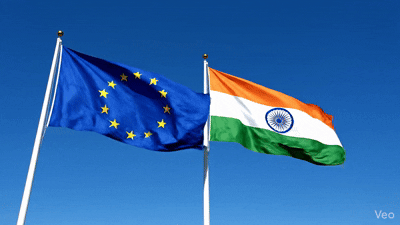
The "Mother of All Deals": Trade as the New Bedrock
The historic conclusion of the EU-India FTA on January 27, 2026, has fundamentally altered the economic math.
The End of Tariff Walls: With the elimination of tariffs on 96.6% of goods, the friction that once defined EU-India trade has evaporated. European heavy industry (machinery, automotive, chemicals) now has unfettered access to a market of 1.45 billion people, while Indian textiles, pharmaceuticals, and services gain privileged entry to the Single Market.
The 100 Billion Anchor: The TEPA deal with the EFTA nations (Switzerland, Norway, Iceland, Liechtenstein), effective since late 2025, set a new global precedent by including a binding commitment of 100 billion dollars in direct investment into India over 15 years. This is not just capital; it is a vote of confidence that anchors European wealth in Indian growth, creating a structural dependency that ensures long-term stability.
The "Silicon Silk Road": A Semiconductor & AI Symbiosis
The most rapid acceleration has occurred in deep tech. The "China Plus One" strategy is no longer a theory; it is being paved in silicon.
From Design to Fab: The "Silicon Silk Road" initiative, solidified during the February 2025 Trade and Technology Council (TTC) meeting in New Delhi, perfectly matches the two regions' strengths. Europe possesses the world’s most advanced lithography (ASML) and R&D institutions (IMEC); India offers the world’s largest pool of chip design talent.
Project GANANA: The launch of the GANANA project in 2025—connecting European supercomputing centers with Indian high-performance computing (HPC) labs—signals a move toward "Sovereign AI." By training AI models on shared, diverse datasets using jointly developed hardware, Europe and India are inoculating themselves against the AI dominance of US Big Tech and Chinese state surveillance models.
Defense: Breaking the Russian Grip
Perhaps the most sensitive and significant shift is in security. For decades, India’s reliance on Russian hardware was a friction point for Europe. The war in Ukraine and Russia’s isolation changed the calculus.
The 2026 Security Partnership: The Security and Defence Partnership signed in January 2026 is a game-changer. It opens the door for European defense majors to co-produce equipment in India. This allows India to diversify its arsenal with high-grade European tech (submarines, jet engines, drones) while revitalizing Europe’s defense industrial base with scale.
Maritime Security: With the Red Sea and Indian Ocean facing continued instability, the joint naval exercises and intelligence sharing mandated by this pact ensure that the trade corridors connecting Europe to Asia remain open and free, independent of US naval guarantees.
Green Capital Meets Global Scale
The climate crisis is the single biggest business opportunity for this alliance.
Financing the Transition: The EU’s recently announced €500 million green support package is merely the seed capital. The real story is the regulatory alignment that allows European pension funds—desperate for yield—to invest in Indian solar, green hydrogen, and battery storage projects with lower risk premiums.
Circular Economy: New agreements on battery recycling and waste-to-hydrogen technologies create a closed loop. Europe exports the technology to recycle critical minerals; India provides the scale to make the recovery of these materials economically viable, reducing both regions' dependence on Chinese rare earths.
The "Human Capital Bridge"
Demographics remain the silent engine of this alliance.
The Great Skill Swap: As of 2026, Germany and Italy face acute labor shortages in healthcare and engineering. The mobility pacts embedded in the new agreements are not just about visas; they are about structured migration. European universities are setting up campuses in India to train talent in situ to European standards, creating a "plug-and-play" workforce that can seamlessly move between the two continents, solving Europe's aging crisis and India's employment challenge simultaneously.
The Third Way
The convergence of the FTA, the Silicon Silk Road, and the Defense Partnership in 2025-2026 represents a shift from transactional ties to strategic intimacy. For investors and policymakers, the message is clear:
The Europe-India corridor is the new hedge against global volatility. It is a partnership that offers Europe the growth it lacks and India the technology it needs, all underpinned by shared democratic values. In a world of uncertain alliances, this is the one bridge that is built to last.


Comments