top of page
Search

Why Current VCs Are Traders, Not Investors
If you ask a General Partner at a top-tier VC firm what they do for a living, they will use noble words like " investing ," " partnering ," and " building ." They will talk about " long-term alignment " and "journeying with the founder ." This is a delusion. Strictly speaking, currently Venture Capital is not the business of investing . It is the business of trading . To understand the distinction, we look to the fundamental definition of the terms: Investing : Buying

Aki Kakko
Dec 31, 20254 min read

The Tyranny of the Roadmap: Why Greatness Cannot Be Planned
In the previous articles, we designed a machine: A high-frequency, self-service VC model that deploys capital dynamically . But why is this machine better at finding outliers than a room full of smart partners? The answer lies in a counter-intuitive discovery from the field of Artificial Intelligence , detailed in the seminal book " Why Greatness Cannot Be Planned " by Kenneth Stanley and Joel Lehman . The central thesis is terrifying to the corporate mind: Setting a spec
Aki Kakko
Dec 29, 20254 min read

The Calculus of Alpha: Why VCs Buy the Past and Miss the Future
In the previous articles, we established that the Venture Capital industry is suffering from a crisis of perception. They mistake the Map for the Territory (confusing selection criteria with system properties). They are trapped in a Monoculture (chasing consensus ). They believe in Inelastic Supply (the "Fixed Pie" fallacy). But there is one final cognitive error that binds all these mistakes together. It is a failure to understand the difference between Position and Vel
Aki Kakko
Dec 27, 20254 min read

"Too Much Capital, Too Few Deals": The Great Venture Capital Lie
If you sit at a dinner table with General Partners from top-tier venture firms , you will inevitably hear a variation of the same complaint: “ The Venture Capital industry is over-saturated. There is too much capital chasing too few deals.” This sentiment has become the accepted wisdom of the post-Zero Interest Rate Policy (ZIRP) era . It posits that the number of Power Law winners —the next Googles, Ubers, and OpenAIs—is a fixed variable . Therefore, pouring more money in
Aki Kakko
Dec 20, 20256 min read

The Monoculture Trap: Why Venture Capital Dies with Consensus
Systems regress toward the mean unless cross-pollinated with other systems. Isolation leads to entropy and mediocrity, while connection leads to vitality and innovation . This principle, borrowed from thermodynamics and evolutionary biology , is perhaps the single most dangerous reality facing the Venture Capital industry today. Venture Capital is an asset class predicated on the Power Law —the idea that one outlier investment will return the entire fund. By definition,
Aki Kakko
Dec 20, 20255 min read

The Physics of Self-Service VC: How to Truly Scale Venture Capital
We have argued that the current artisanal model of VC —partners drinking coffee, reading pitch decks , and making " gut " decisions—cannot scale. It is a boutique service trying to address a global innovation deficit. To capture the true breadth of the Power Law , we must move from a Service Business to a Software and Platform Business. We must build the " Amazon Web Services of Capital. " But how does the math actually work? How do you organize a funnel that processes 100,0
Aki Kakko
Dec 19, 20254 min read

Weapons of Mass Startup Destruction: How VCs Kill Companies
In the sanitized folklore of Silicon Valley, Venture Capital is depicted as "fuel." It is the benevolent energy that allows a small idea to grow into a world-changing giant. The VC is the "partner," the "coach," the "sherpa." But in the boardrooms of the largest funds , capital is viewed very differently. It is not just fuel; it is a weapon. And like any weapon, it causes collateral damage. To understand why VCs frequently destroy the very companies they invest in, you
Aki Kakko
Dec 18, 20254 min read

The End of the "Round": Dynamic Allocation and the Future of VC
We have established that the math of VC requires a Power Law approach . We have argued that the structure must shift to Permanent Capital . But there is still a massive friction point in the daily life of a founder : The Fundraising. In the current ecosystem, financing is binary . You are either "fundraising" (distracted, pitching, negotiating) or "building" (executing). This results in a "Step Function" growth curve: Starvation: The company runs low on cash. Panic sets i
Aki Kakko
Dec 18, 20255 min read

Why Venture Capital Kills Compounding
In the previous articles, we dismantled the VC selection process ( The Map is Not the Territory ), exposed the psychological barriers ( Fear of Looking Stupid ), and revealed the misalignment of incentives in fundraising ( Why VCs Make "Bad" Bets on Purpose ). But even if a VC firm gets everything else right—if they use data to find the outlier , ignore the herd to buy at the right price , and avoid the ego trap—they still face a structural wall that prevents them from cap
Aki Kakko
Dec 16, 20254 min read

Why VCs Make "Bad" Bets on Purpose
In our previous articles, we explored the mathematics of the Power Law , the psychology of the Fear of Looking Stupid (FOLS) , and the technological inevitability of the "Ghost in the Deal" (data-driven investing) . But there is one lingering question that math and technology cannot explain. If the logic of "contrarian, data-driven farming" is so obvious, why do so many top-tier firms continue to herd into over-valued, hyped-up rounds that make no mathematical sense? Why do s
Aki Kakko
Dec 16, 20254 min read

The Ghost in the Deal: Why Venture Capital Must Become Software
In The Map is Not the Territory , we established that the Power Law is a system property, not a selection filter. In Why the Smartest Money Looks the Stupidest , we identified the psychological barrier—Fear of Looking Stupid (FOLS)—that prevents investors from capturing that value. Now, we must address the Execution. If the math suggests we should be "farming" for outliers rather than "sniping" for certainty, and if the psychology requires us to ignore social consensus, then
Aki Kakko
Dec 15, 20255 min read

Why the Smartest Money in VC Looks the Stupidest
In my previous article, The Map is Not the Territory , we established that the Power Law is a system property, not a selection filter. We argued that VCs fail when they try to predict the magnitude of success rather than focusing on uncapped optionality . But if the logic is so sound—if the math of "planting seeds" clearly outperforms the arrogance of "sniping winners"—why do so few investors actually behave this way? The answer isn’t analytical. It is emotional. The sing
Aki Kakko
Dec 13, 20254 min read
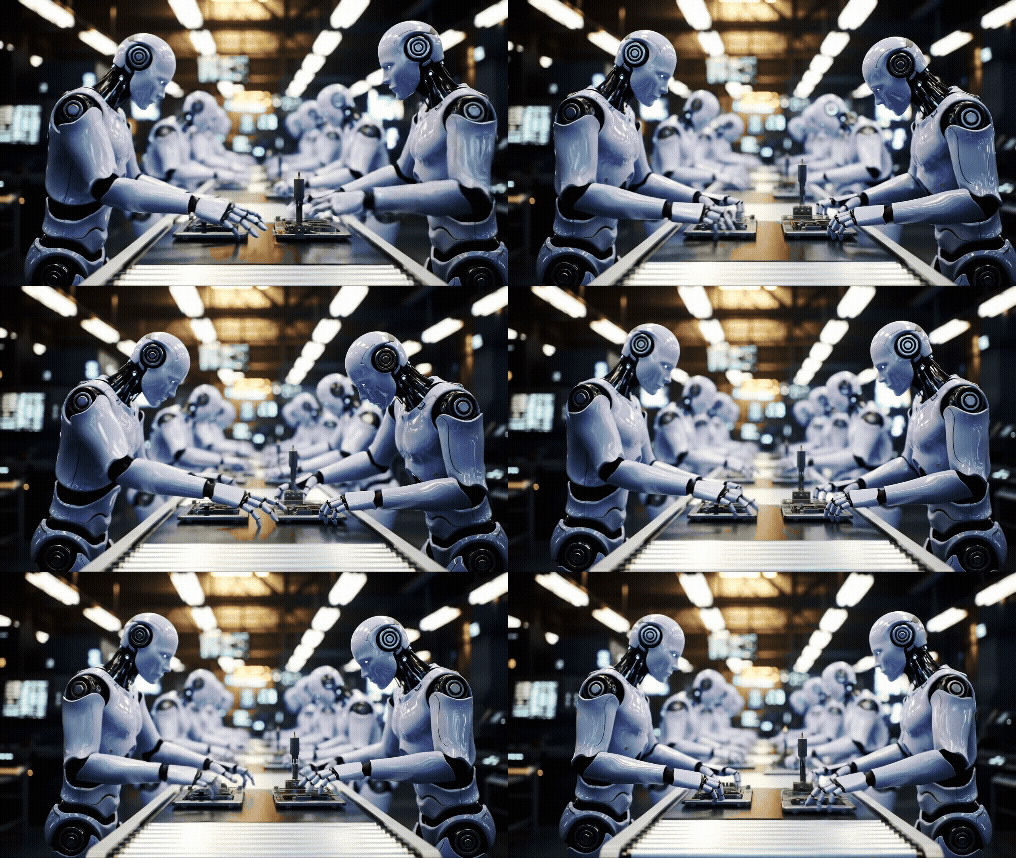
Semantic Telepathy: Why the future of AI Agent communication is silent, instant, and incomprehensible to humans
If you were to observe two advanced Artificial Intelligence agents collaborating today—for instance, a coding agent architecting software while a debugging agent reviews it—the process is surprisingly archaic. They generate paragraphs of English text, transmit them via APIs , parse the text, and then regenerate a new response. It is the digital equivalent of two supercomputers communicating via smoke signals. Natural language—whether English, Mandarin, or Python code—is
Aki Kakko
Dec 6, 20255 min read

The Poker Paradox: Why VCs Hate Competition (It’s Not About the Odds, It’s About Survival)
There is a popular heuristic in Silicon Valley , famously championed by Peter Thiel in Zero to One , that competition is for losers. The logic is often explained using a poker analogy : professionals would rather play "heads up" (one-on-one) with a good hand than play against a full table of competitors. The common explanation is that playing against a crowded table makes you a "statistical loser." The math usually cited looks like this: holding Ace-King offsuit against one
Aki Kakko
Dec 5, 20254 min read

The Architecture of Absence: Why Intelligence is Knowing What is Missing
In the evolution of information theory and artificial intelligence , a single maxim has largely defined our definition of smartness: "Compression is understanding ." The logic, championed by pioneers from Claude Shannon to modern AI researchers , is elegant. To compress a complex dataset effectively, one cannot merely discard parts at random. One must identify the underlying patterns, the causal links, and the redundancies. If you can boil a law of physics down to E=mc^
Aki Kakko
Dec 4, 20256 min read

The Hidden Code: The Mathematics Underlying Human Language
Language is often viewed as the ultimate expression of human creativity —organic, evolving, and emotional. Mathematics, conversely, is seen as the realm of rigid structure and cold logic. Yet, beneath the surface of poetry, code, and casual conversation, language is governed by strict mathematical laws. For the modern Data Scientist or AI enthusiast, understanding these roots isn't just academic—it is the key to understanding how Large Language Models (LLMs) like GPT wor
Aki Kakko
Dec 2, 20256 min read

From Dust to Desire: The Physical Origins of Agency and the Future of AI
One of the most profound questions in science and philosophy is the "Problem of Agency ." The universe involves fundamental laws of physics that describe how matter interacts—atoms collide, gravity pulls, energy disperses. In this mechanical universe , things simply happen . Yet, living beings are different. Living things don’t just happen; they act. A rock rolls down a hill because gravity forces it to. A wolf runs up a hill because it wants to catch a rabbit. Where does
Aki Kakko
Dec 1, 20257 min read
bottom of page